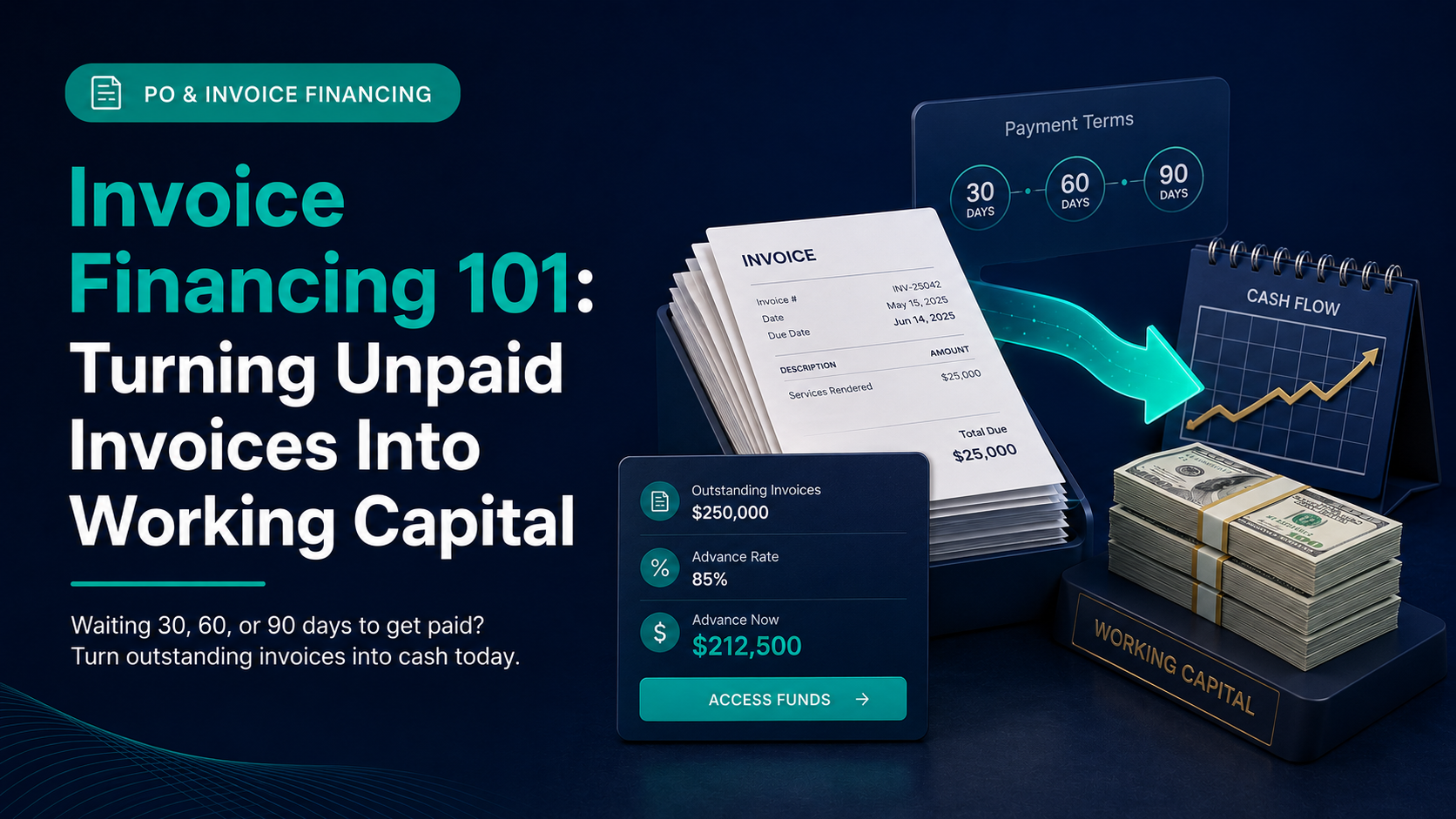
Here’s a strange reality of running a B2B business: you can be profitable on paper and still run out of cash. You’ve delivered the product, sent the invoice, and technically earned the revenue — but if your customer pays on 60-day terms, that money might as well not exist for two months. Invoice financing exists to close that gap.
The plain-English definition
Invoice financing is a type of funding where a lender advances you a percentage of the value of an outstanding invoice — money your customer already owes you — before that invoice is actually due. When your customer eventually pays, the advance is repaid, typically along with a fee, and you receive the remaining balance (minus the fee) if it wasn’t advanced upfront.
It’s not a loan against your future revenue in a general sense. It’s specifically tied to invoices that already exist for work you’ve already completed and delivered.
How the process works
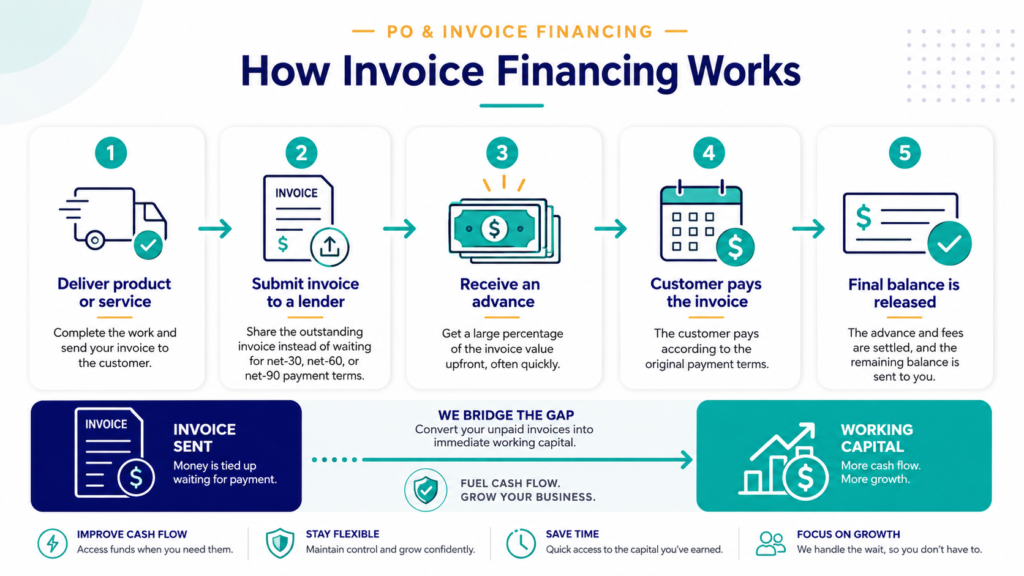
The key underwriting factor is the creditworthiness of your customer — the business that owes the invoice — not necessarily your own credit profile. A lender is essentially betting on the likelihood that your customer pays what they owe.
Why growing businesses use invoice financing
It converts revenue you’ve already earned into cash you can use now. You’re not borrowing against hypothetical future sales — you’re accelerating money that’s already yours, just sitting in accounts receivable.
It smooths out long payment terms. Net-60 and net-90 terms are common in B2B relationships, especially with larger retail or enterprise customers who have leverage to dictate payment schedules. Invoice financing lets you offer those terms to win the business without starving your own cash flow while you wait.
It scales with your sales. The more you invoice, the more financing capacity you generally have available — unlike a fixed loan amount that doesn’t move as your business grows.

What to consider before using invoice financing
The fee structure matters — understand whether it’s a flat fee, a rate that increases the longer the invoice remains unpaid, or some other structure, and how that compares to simply waiting for payment. It’s also worth understanding whether the arrangement is “recourse” (you’re responsible if your customer doesn’t pay) or “non-recourse” (the lender absorbs that risk), since this materially changes who bears the risk of a customer default.
Some businesses also prefer to keep the relationship discreet — whether your customer is aware that an invoice has been financed depends on the structure and lender, and it’s worth asking about upfront if that matters to you.
Invoice financing vs. PO financing
These two are often confused because they solve adjacent problems. PO financing covers the cost of fulfilling an order before it ships — it’s about paying your supplier. Invoice financing covers the gap after an order has shipped and been invoiced, while you wait for your customer to pay. Many businesses use PO financing to fulfill an order, then invoice financing once that order ships, to cover the full cycle from purchase order to payment. We break this comparison down in more detail in a dedicated post.
Who this fits best
Invoice financing tends to be the strongest fit for B2B businesses that:
- Extend net-30, net-60, or longer payment terms to customers
- Have creditworthy customers with a track record of paying on time, just not quickly
- Need working capital to cover payroll, supplier payments, or growth while waiting on receivables
- Want financing that scales naturally with sales volume
FAQ
Will my customer know I’m using invoice financing? This depends on the specific arrangement and lender — some structures are fully disclosed to the customer, others are not. It’s worth discussing this directly if discretion matters to your business.
What percentage of the invoice can I access upfront? This varies by lender, industry, and the specific invoice, but a significant majority of the invoice value is typical, with the remainder released after your customer pays, minus fees.
What happens if my customer doesn’t pay? This depends on whether the financing is recourse or non-recourse — a detail worth clarifying before you commit to any specific offer, since it determines who bears the risk of non-payment.