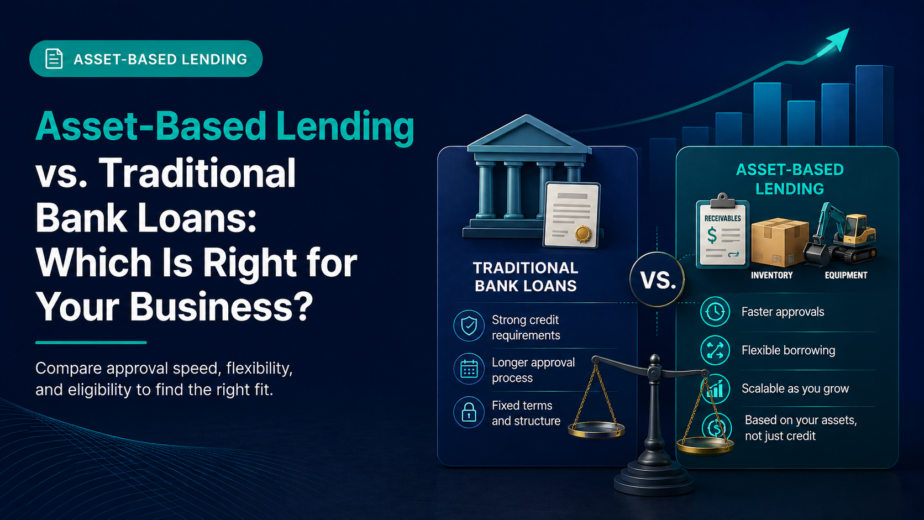
Every growing business eventually runs into the same frustrating math problem: the assets are there, but the cash isn’t. You’ve got inventory on the shelves, equipment on the floor, or invoices out with customers — real value, sitting there, not doing anything for you today. Asset-based lending is built to solve exactly that problem.
The plain-English definition
Asset-based lending (often shortened to ABL) is a type of financing where a business borrows money using its own assets as collateral, rather than relying purely on credit history or projected revenue. Those assets can include accounts receivable, inventory, equipment, machinery, or in some cases real estate. Instead of a lender asking “how strong is your credit profile,” the primary question becomes “how much value do your assets represent, and how much can you borrow against them.”
Because the loan is secured by something tangible, asset-based lending can open the door to larger credit facilities and more competitive rates than unsecured financing — particularly for asset-heavy businesses that might not qualify for a comparable amount through a traditional cash-flow-based loan.

How it actually works
Once you’re approved, a lender assigns a value to your qualifying assets — this is typically a percentage of the asset’s appraised or book value, not the full amount, since the lender needs a cushion in case the asset needs to be liquidated. Accounts receivable, for example, are usually advanced at a higher percentage than inventory, since receivables are closer to becoming cash. You then draw against that value as needed, similar to a line of credit, or receive it as a lump sum depending on the structure.
As you sell inventory, collect on receivables, or use equipment to generate revenue, you repay the facility — and depending on the lender, the available credit can revolve, meaning it replenishes as you pay it down and your qualifying asset base grows.
What makes asset-based lending different from a typical business loan
A conventional term loan is underwritten primarily on your business’s overall creditworthiness and cash flow history. Asset-based lending shifts a meaningful part of that equation onto the value of what you already own. That’s a real advantage for businesses that are asset-rich but might have thinner credit history, seasonal revenue swings, or a recent rough patch that doesn’t reflect the underlying strength of the business.
It also tends to scale with the business. As your receivables grow or your inventory position expands, the amount you can access can grow with it — which is different from a fixed-amount term loan that doesn’t move once it’s funded.
When asset-based lending makes the most sense
This structure tends to be the strongest fit for businesses that are:
- Asset-heavy relative to cash flow — manufacturers, distributors, and wholesalers with significant inventory or equipment on the books
- Managing a receivables gap — companies waiting 30, 60, or 90 days to get paid by customers, but needing capital now to keep operating
- Scaling quickly — businesses whose asset base is growing fast enough that a fixed loan amount would be outdated within a few months
- Coming off an uneven year — businesses whose recent financials don’t fully reflect their current trajectory, but whose assets tell a stronger story
If your business doesn’t carry significant inventory, equipment, or receivables, asset-based lending may not be the most efficient option — a revenue-based or cash-flow structure might be a better match, which is exactly the kind of comparison a funding marketplace is built to help you make.
A realistic example
Picture a distribution company that just landed a large new retail account. The order is real, the margin is good, but fulfilling it means buying significantly more inventory than usual, months before the retailer pays on its 60-day terms. A term loan sized for last year’s revenue won’t stretch to cover it. Asset-based lending, sized against the receivables and inventory tied to that account, can close the gap between “we won the order” and “we got paid for it.”

What assets typically qualify? Accounts receivable, inventory, and equipment or machinery are the most common. Some lenders also consider real estate. Each asset type is typically advanced at a different percentage of its value.
Is asset-based lending only for large companies? No. While it’s common among larger, asset-heavy businesses, it’s also a strong fit for growing small and mid-sized businesses in manufacturing, distribution, and wholesale that have meaningful inventory or receivables but need capital faster than their cash flow allows.
Does my business need perfect credit to qualify? Asset-based lending places significant weight on the value of your collateral, which can make it more accessible than a purely credit-based loan for businesses with a strong asset position but a less-than-perfect credit history.