Most business owners spend more time researching a new piece of equipment than they do comparing financing offers — which is understandable, since equipment specs are easier to compare than loan terms buried in paragraphs of fine print. But the offer you accept will shape your cash flow for months or years. A few sharp questions, asked before you sign anything, can save you from a structure that looks fine on the surface but works against you in practice.
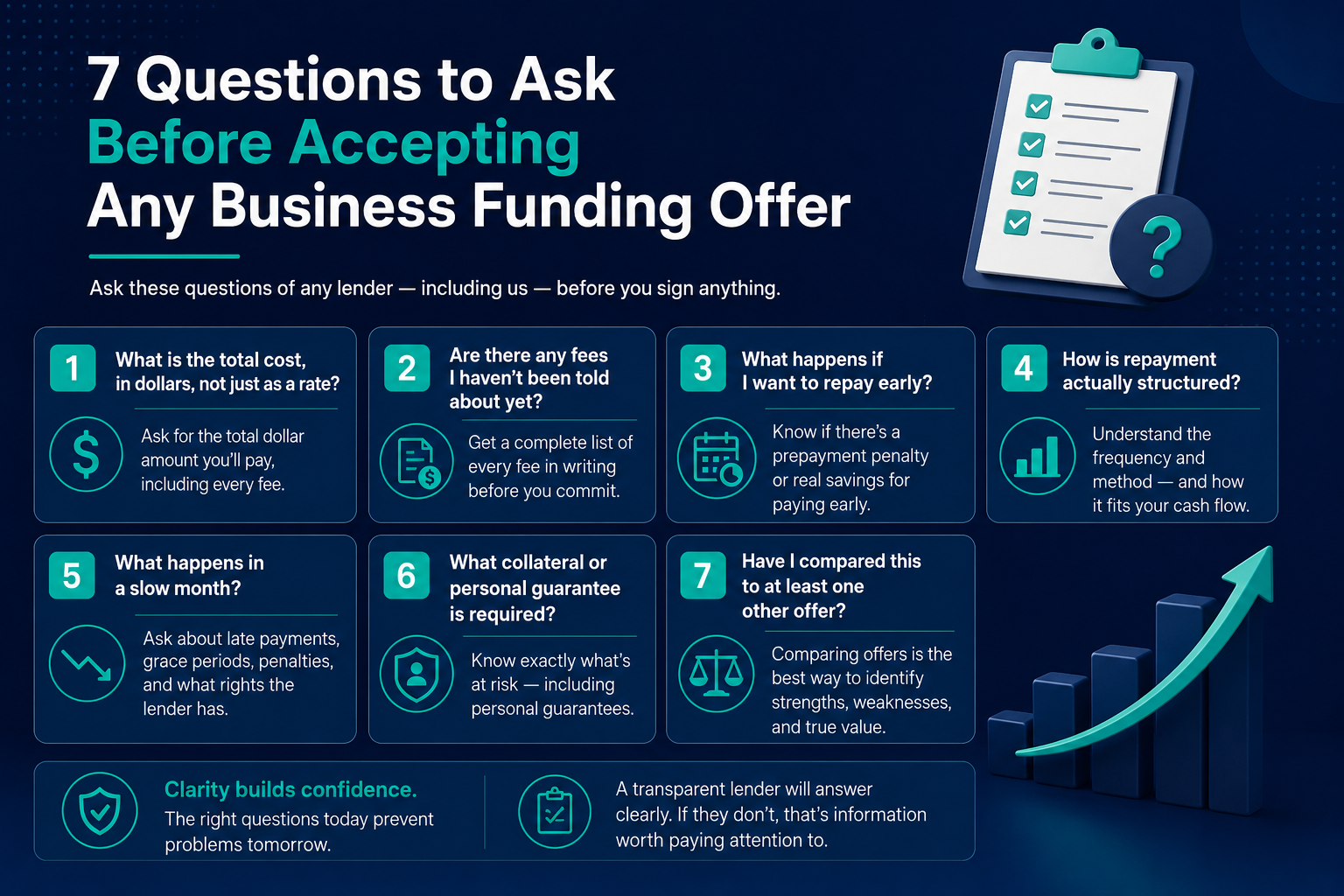
This isn’t a Yardline-specific checklist. Ask these questions of any lender — including us.
1. What is the total cost, in dollars, not just as a rate?
A headline interest rate or factor rate can obscure the actual dollar cost of financing, especially when fees are layered on separately. Ask directly: “If I take this offer and repay it on schedule, what is the total dollar amount I will have paid, including every fee?” A transparent lender should be able to answer this immediately, in plain numbers, without redirecting you back to a rate.
2. Are there any fees I haven’t been told about yet?
Origination fees, closing costs, draw fees, maintenance fees — the list of potential add-ons can be long, and they don’t always show up in the first conversation. Ask for a complete list of every fee associated with the offer, in writing, before you commit. If a lender is hesitant to provide this clearly, treat that hesitation as information.
3. What happens if I want to repay early?
Some financing structures charge a prepayment penalty specifically to discourage you from paying off the balance ahead of schedule — which can be a red flag, since it suggests the lender is optimizing for the full term of interest rather than for your business’s flexibility. Others allow early repayment with real savings on total interest. Know which one you’re looking at before you sign.
4. How is repayment actually structured?
Fixed monthly payment? A percentage of revenue? Daily or weekly withdrawals? The mechanics matter as much as the total cost. A repayment structure that doesn’t match your business’s cash flow pattern — for example, daily withdrawals for a business with seasonal, lumpy revenue — can create cash flow strain even if the total cost is reasonable on paper.
5. What happens in a slow month?
Ask directly what happens if revenue dips, a payment is late, or a specific covenant isn’t met. Is there a grace period? A penalty? Does the lender have the ability to seize collateral or accelerate the full balance? Understanding the downside scenario matters more than the best-case scenario, because the best case rarely requires asking questions.
6. What collateral or personal guarantee is required?
Some financing requires a personal guarantee, meaning you’re personally on the hook if the business can’t repay, beyond just the business’s own assets. Others are secured only by business assets or by the specific transaction (as with PO or invoice financing). Know exactly what’s at risk before you sign, not after.
7. Have I compared this to at least one other offer?
This is the simplest and most overlooked question of all. A single offer, evaluated in isolation, is very hard to judge — you have nothing to measure it against. The moment you have a second offer to compare, weaknesses and strengths in the first one tend to become obvious. This is exactly why comparing multiple offers, rather than accepting the first one you receive, tends to produce meaningfully better outcomes — not because the first offer is necessarily bad, but because you can’t know that without something to compare it to.

Why this list exists
Every one of these questions has a simple, honest answer when you’re dealing with a transparent lender. If a lender is vague, defensive, or redirects you when you ask them, that’s useful information in itself — arguably more useful than the answer to the question you originally asked.
FAQ
Is it rude to ask a lender these questions directly? No. A legitimate lender expects and welcomes these questions — they’re standard due diligence, not an accusation. Hesitation or defensiveness in response is a much bigger concern than the questions themselves.
Should I ask these questions even if I’m in a hurry to get funded? Especially then. Financial decisions made under time pressure are exactly the ones most likely to be regretted later. A few extra minutes of questions rarely delays funding meaningfully, but can prevent a structure that causes real problems down the road.
What if I don’t understand the answer I get? Ask for it in plainer terms, or ask for an example using your actual numbers. A lender who can’t explain their own terms in language you understand is not making the terms easier to accept by using jargon — that’s a signal worth paying attention to.