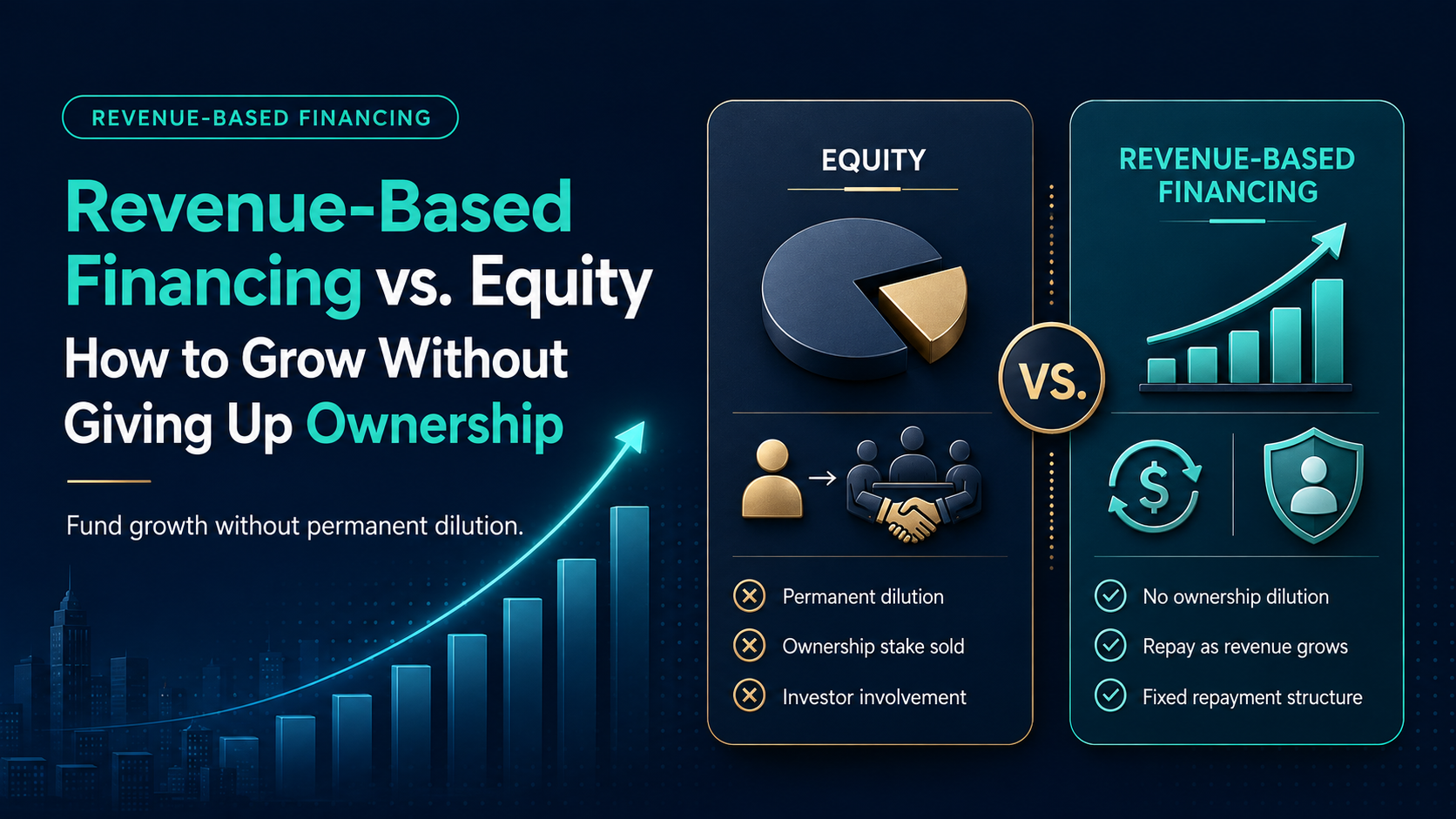
Every founder eventually has the same conversation with themselves: the business needs capital to grow, and there are really only two fundamentally different ways to get it. Sell a piece of the company, or borrow against its future. Revenue-based financing sits firmly in the second category — and understanding the real tradeoffs between the two can save you from giving up more than you needed to.
What you’re actually trading away
With equity financing, you’re selling a permanent stake in your company in exchange for capital. That stake doesn’t go away when the capital is “paid off” — because equity is never paid off. An investor who owns 15% of your company today owns 15% of it in five years, in ten years, and at whatever valuation your company eventually reaches, whether that’s ten times higher or lower than today.
With revenue-based financing, you’re borrowing capital and repaying it as a percentage of revenue until a fixed total is reached. Once that repayment is complete, the relationship is over. You don’t owe anything further, and you haven’t given up any ownership in the process.

Why this distinction matters more than people initially think
Founders often underestimate how expensive equity becomes in hindsight. Capital that felt reasonable to give up for 10-15% of the company at an early stage can end up representing an enormous dollar value if the company succeeds — a cost that’s invisible at the moment of the deal but very visible years later. Debt-based capital, including revenue-based financing, has a defined, calculable cost from day one: you know what you’ll repay in total, regardless of how the company’s valuation moves afterward.
That’s not an argument against ever raising equity — equity capital, especially from the right investors, can bring more than money: expertise, networks, credibility. But it’s a reason to be deliberate about when you use it, rather than defaulting to equity for every capital need simply because it’s the most familiar path.
When revenue-based financing is the better tool
When you need capital for a specific, revenue-generating initiative. Inventory ahead of a busy season, a marketing campaign with a known return profile, expanding into a new sales channel — these are situations where the capital directly drives the revenue that repays it, which is exactly what revenue-based financing is built for.
When your business has predictable revenue but doesn’t need or want a board seat attached to the capital. Equity investors typically want governance rights, reporting requirements, and a say in major decisions. Revenue-based financing doesn’t come with that.
When you’re not trying to raise a “round.” Equity fundraising is a significant time investment — pitch decks, investor meetings, due diligence, negotiation. If you need capital for a specific near-term need, a revenue-based structure can often move faster than a full equity process.
When equity is still the better tool
When the capital need isn’t tied to a clear, near-term revenue outcome — long-horizon R&D, for example, where repayment tied to current revenue wouldn’t make sense yet.
When you specifically want the involvement, network, or credibility that a strong investor brings, beyond just the capital itself.
When your business isn’t yet generating the consistent revenue that a lender would underwrite against — revenue-based financing depends on having revenue to base the structure on.
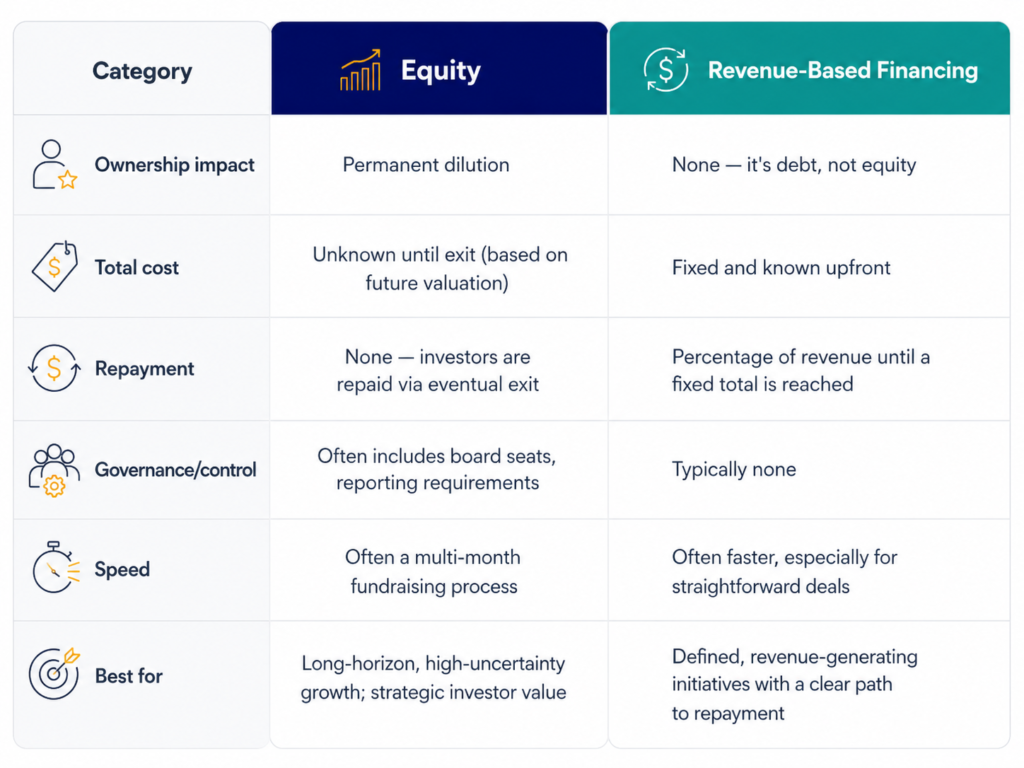
A side-by-side comparison
FAQ
Can I use both equity and revenue-based financing? Yes — many businesses raise equity for foundational, longer-horizon growth and use revenue-based financing for specific, shorter-horizon initiatives like inventory or marketing spend. They’re not mutually exclusive.
Is revenue-based financing cheaper than equity? It depends entirely on your company’s eventual outcome. If your company grows significantly in value, equity you gave up early can end up being far more expensive in hindsight than a fixed-cost revenue-based facility would have been — but if the company’s value doesn’t grow much, the comparison could go the other way. The point isn’t that one is always cheaper — it’s that revenue-based financing has a known, fixed cost, while equity’s true cost isn’t known until much later.
Does revenue-based financing show up as debt on my balance sheet? Generally, yes, since it’s a debt obligation rather than equity — though the specific accounting treatment can vary, and it’s worth discussing with your accountant for your specific structure.