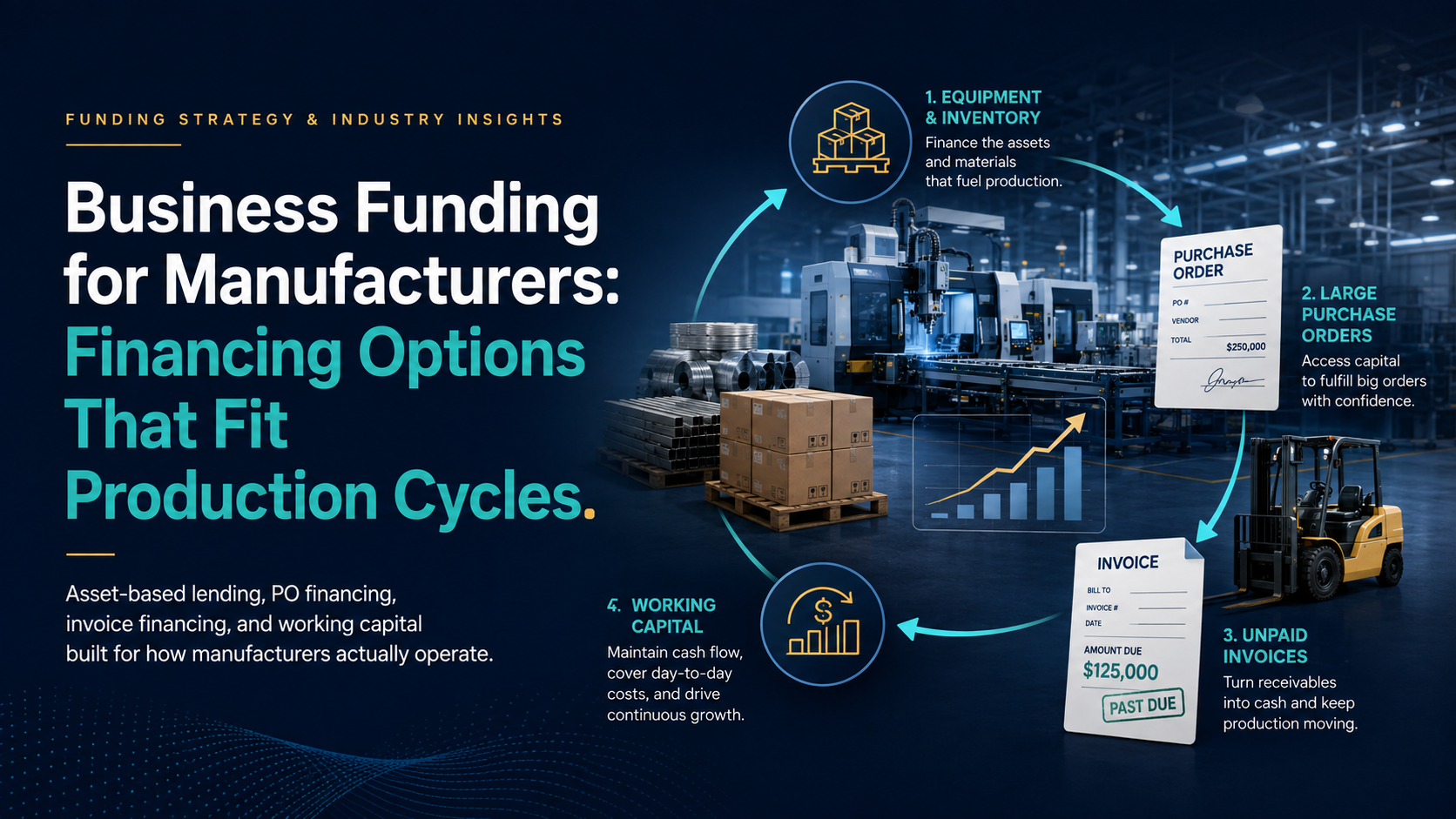
Manufacturing businesses run on a cash flow pattern that most generic financing products weren’t really designed around: significant capital goes out for raw materials and labor well before a finished product generates a single dollar of revenue. A term loan sized for last year’s numbers doesn’t necessarily account for the specific rhythm of production cycles, raw material costs, and customer payment terms that define how cash actually moves through a manufacturing business.
Why manufacturers face a distinct financing challenge
A manufacturer’s cash conversion cycle is often longer and more capital-intensive than a typical service or retail business. Raw materials have to be purchased, converted into finished goods over a production timeline that can stretch weeks or months, and then sold — frequently on payment terms of 30, 60, or even 90 days for larger commercial or retail customers. That means capital gets tied up at multiple points simultaneously: in raw materials, in work-in-progress inventory, in finished goods waiting to ship, and in receivables waiting to be paid.
This is exactly the kind of situation where matching the financing structure to the specific point of the cash flow gap — rather than defaulting to a single generic loan — makes a meaningful difference.
Asset-based lending for equipment-heavy operations
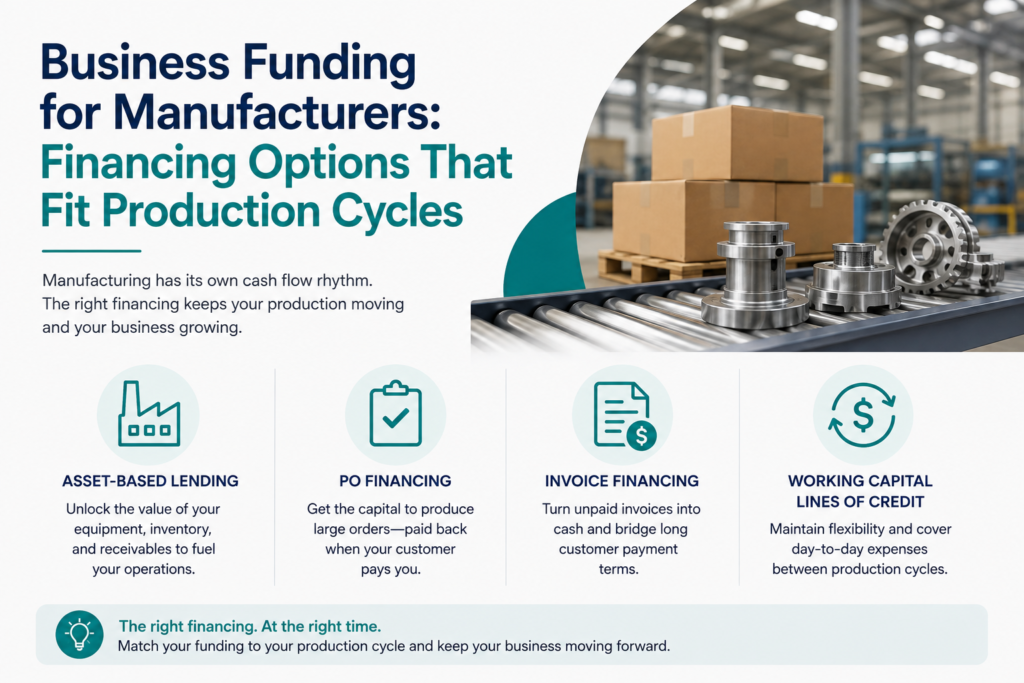
Manufacturers typically carry significant value in machinery, equipment, and inventory — precisely the kind of assets that asset-based lending is built around. Rather than being limited by cash flow-based underwriting alone, an asset-based facility can reflect the real value sitting on your production floor and in your warehouse, often unlocking more capital than a traditional loan would based on financials alone. As your inventory and receivables grow with increased production, the available credit can grow alongside it.
PO financing for large, order-specific production runs
When a manufacturer lands a large order — a new retail account, a bulk commercial contract — the cost of the raw materials and labor needed to fulfill it can exceed what’s comfortable to pay out of existing cash reserves. PO financing exists specifically for this scenario: capital tied to the confirmed order, used to fund production, repaid once the customer pays for the completed order. It lets a large order become an opportunity rather than a cash flow crisis.
Invoice financing for extended customer payment terms
Once a production run ships and is invoiced, manufacturers frequently face 30, 60, or 90-day payment terms from larger commercial and retail customers — terms that are often non-negotiable if you want to keep that account. Invoice financing bridges that gap, converting an earned but unpaid invoice into usable working capital, so the next production cycle isn’t held hostage by the payment timeline of the last one.
Working capital lines of credit for ongoing operational flexibility
Beyond specific orders or invoices, manufacturers often benefit from a revolving line of credit to smooth out the general rhythm of production — covering payroll, utilities, and routine material purchases during periods between major order-driven financing needs. A line of credit provides access to capital as needed, without committing to a fixed loan amount that may not match the actual timing of when cash is needed.
Matching financing to your specific production cycle
The right structure — or combination of structures — depends on where your business’s cash flow gaps actually occur:
- Capital tied up in equipment and existing inventory? Asset-based lending.
- Can’t afford to produce a specific large order? PO financing.
- Shipped the order, now waiting on a long payment term? Invoice financing.
- Need ongoing flexibility beyond any single order? A working capital line of credit.
Many manufacturers use more than one of these at different points in their production and sales cycle, rather than relying on a single financing product to cover every kind of gap.
FAQ
Does my manufacturing business need to be a certain size to qualify for asset-based lending? Asset-based lending is generally more about the value and quality of your assets than the overall size of your business — smaller manufacturers with meaningful equipment or inventory value can qualify, not just large operations.
Can I use PO financing for repeat orders from the same customer, or only new ones? PO financing can generally be used for any confirmed purchase order, whether from a new customer or a repeat order from an existing one, as long as the order itself qualifies.
What if my production costs fluctuate with raw material prices? This is common in manufacturing, and it’s worth discussing directly with a funding specialist — asset-based and PO financing structures can often be sized to account for this kind of variability rather than assuming static costs.