
Revenue-based financing gets a lot of attention because the pitch is genuinely appealing: no fixed payment regardless of how business is going, no equity given up, repayment that scales with performance. But it isn’t automatically the right fit for every business or every capital need. These five questions will give you a more honest read than the marketing pitch alone.
1. Do I have consistent, verifiable revenue?
Revenue-based financing is underwritten against your revenue history and trajectory. If your business has a track record — even a seasonal or variable one, as long as there’s a discernible pattern — lenders can reasonably project how repayment will play out. If your revenue is brand new, highly erratic with no clear pattern, or difficult to verify, revenue-based financing may be harder to access, or the terms may be less favorable than they would be for a business with a clearer track record.
Honest self-check: Could you show a lender six to twelve months of revenue data that tells a coherent story? If yes, this is likely a viable path. If your revenue history is thin or inconsistent, it’s worth having a direct conversation with a funding specialist about whether this is the right moment for this structure, or whether a different product fits better right now.
2. Is the capital going toward something that will generate revenue?
Revenue-based financing works best when there’s a relatively direct line between the capital and the revenue that will repay it — inventory ahead of a busy season, a marketing campaign, expansion into a new channel. If you’re funding something with a longer or less direct path to revenue — a long-term R&D initiative, for example — the repayment structure may start before the initiative has generated the revenue to comfortably support it.
Honest self-check: If you drew a straight line from “the capital gets deployed” to “revenue increases as a result,” how long and uncertain is that line? Shorter and more direct is a better fit for revenue-based financing.
3. Am I comfortable with a repayment amount that’s fixed in total, even though the pace varies?
This is the detail that’s easy to gloss over: while the monthly payment flexes with revenue, the total amount you’ll repay is typically fixed upfront. A business that repays quickly, because revenue is strong, ends up paying that fixed amount over a shorter period — which means a higher effective annualized cost than a business that repays more slowly. This isn’t a flaw in the structure, but it’s a tradeoff worth understanding clearly before you commit, rather than discovering it after the fact.
Honest self-check: Have you asked what the total repayment amount looks like under both a fast-repayment and a slow-repayment scenario, and are you comfortable with both outcomes?
4. Do I actually need to avoid a fixed monthly payment, or would I prefer the predictability of one?
The flexibility of revenue-based financing is a genuine advantage for businesses with seasonal or unpredictable revenue. But if your business has stable, predictable cash flow, a fixed-payment structure — like a traditional term loan — might offer a more competitive cost, since the lender isn’t pricing in the flexibility that revenue-based structures build in.
Honest self-check: Is your revenue genuinely variable enough that a fixed payment would create real strain in slower months? Or is your cash flow predictable enough that you’d be paying for flexibility you don’t actually need?
5. Have I compared this to at least one alternative structure?
This is true of any financing decision, but it’s especially relevant here, because revenue-based financing is often marketed heavily on its flexibility without always emphasizing the fixed total repayment cost. Comparing it directly against an asset-based facility, a line of credit, or a traditional term loan — using your actual numbers — is the only way to know whether the flexibility is worth what you’re paying for it in your specific situation.
Honest self-check: Have you seen an actual competing offer with real numbers, or are you evaluating revenue-based financing in isolation?
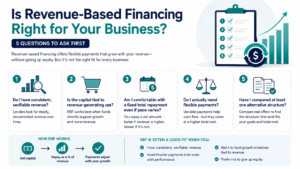
What to do with your answers
If most of your answers point toward “yes, this fits” — consistent revenue, a clear revenue-generating use of funds, comfort with the fixed-total structure, a genuine need for payment flexibility — revenue-based financing is likely worth pursuing seriously. If several answers gave you pause, that’s not a reason to rule it out entirely, but it is a reason to have a direct conversation with a funding specialist about how it compares to other structures for your specific situation, rather than assuming it’s automatically the right fit because it’s the one you’ve heard the most about.
FAQ
Can I switch from revenue-based financing to a different structure later if it’s not working well for my business? This depends on your specific agreement and lender. It’s worth understanding the terms around this before committing, rather than assuming flexibility that may not exist in the contract.
Is revenue-based financing harder to qualify for than a traditional loan? Not necessarily harder — it’s evaluated differently. Businesses with strong, verifiable revenue but a shorter operating history or less-than-perfect credit sometimes find it more accessible than a traditional bank loan, since the underwriting emphasis is different.
Does seasonal revenue disqualify me? No — revenue-based financing is often well-suited to seasonal businesses specifically because the repayment structure flexes with revenue, as long as the seasonal pattern is clear and verifiable.