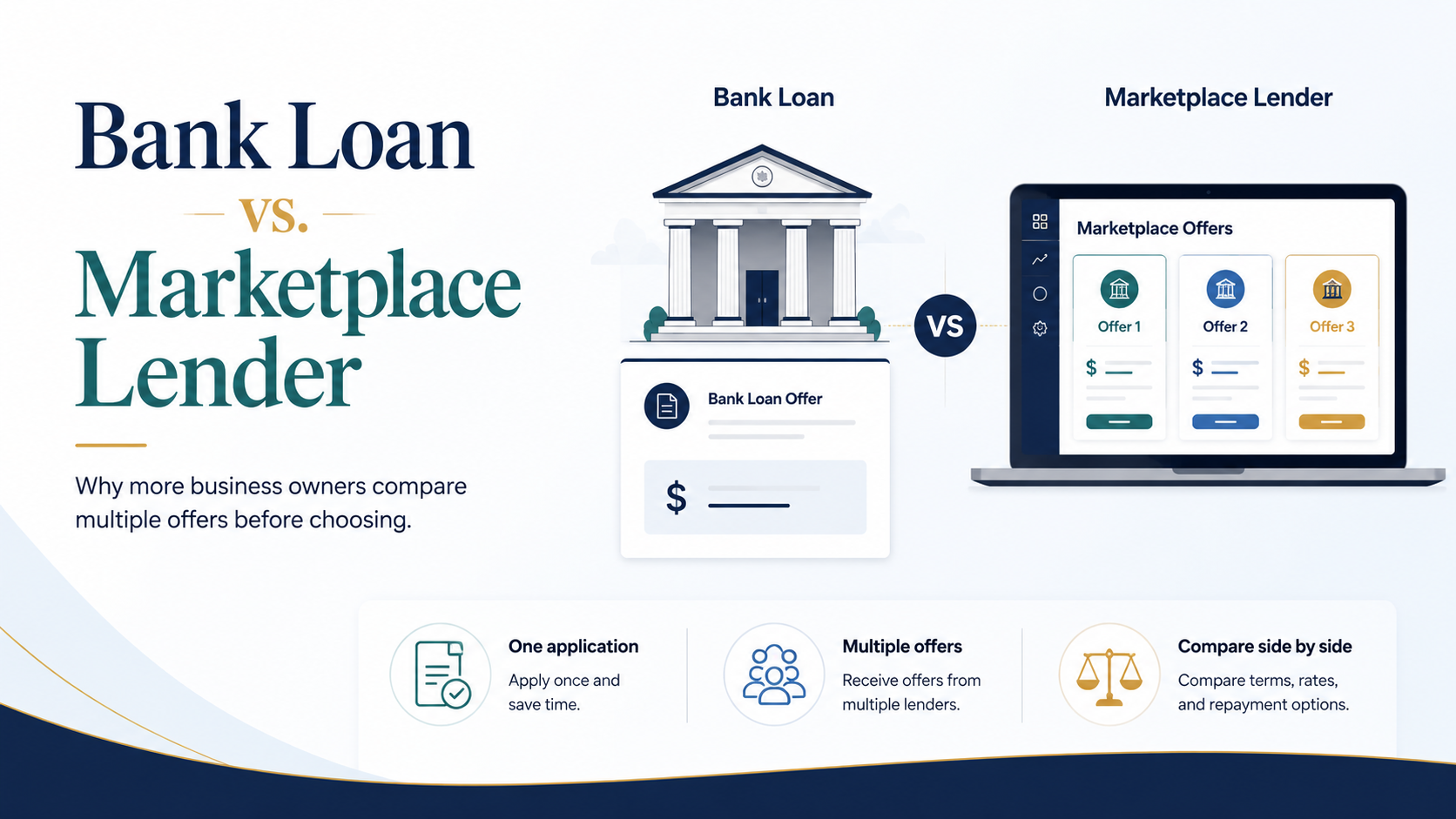
For decades, getting business financing meant walking into a bank, applying, and hoping for the best — and if the answer was no, starting over somewhere else. That single-lender approach is quietly becoming the exception rather than the rule, as more business owners realize that comparing several real offers, rather than accepting the first one, tends to produce a meaningfully better outcome. Here’s what’s actually changed, and why it matters for how you approach your next financing decision.

The single-lender approach, and its built-in limitation
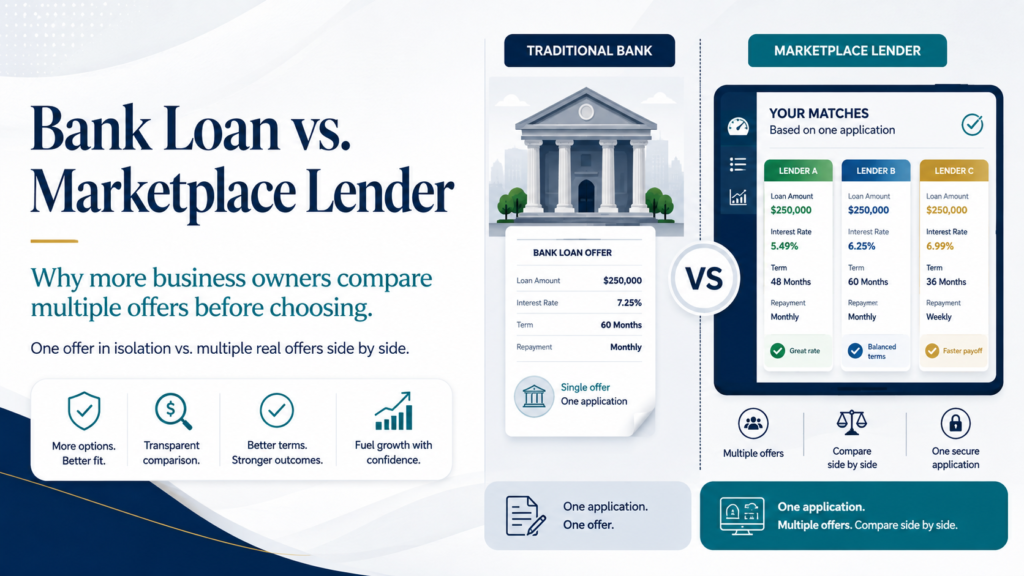
When you apply to a single bank or lender, you get exactly one product, priced and structured however that institution chooses. If it’s a good fit, great. If it’s not quite right — the collateral requirements don’t match your asset mix, the term doesn’t fit your cash flow, the rate reflects a risk profile that doesn’t account for something specific about your business — you have no real point of comparison to know that. You’re evaluating one offer in isolation, which is a little like buying a car after seeing exactly one for sale.
What a marketplace model changes
A funding marketplace like Yardline doesn’t replace individual lenders — it aggregates access to many of them through a single application, so you can see multiple real offers side by side instead of one. That single structural change has a few concrete effects:
You see what “competitive” actually means for your specific business. A rate or term that sounds reasonable in isolation can look quite different once you see two or three alternatives for the exact same borrowing need. Comparison reveals things a single offer simply can’t.
You’re more likely to land on the right structure, not just the available one. A single lender offers what they offer — asset-based, a term loan, a line of credit, whatever their specialty is. A marketplace with access to 30+ partners across multiple financing types can match you to the structure that actually fits your situation, rather than fitting your situation into whatever one lender happens to sell.
The process is faster than applying to multiple lenders separately. Comparing offers used to mean repeating the entire application process — different forms, different document requests, different timelines — for every lender you wanted to compare. A single application that surfaces multiple offers removes that redundancy entirely.
Where a direct bank relationship still has real value
This isn’t an argument that banks are obsolete. A long-standing bank relationship can offer real value — particularly for businesses with strong, clean credit and straightforward financing needs, where a bank’s rates can be genuinely competitive, and where the relationship itself carries value beyond any single transaction. The point isn’t “banks are bad” — it’s that a single offer, evaluated without comparison, is a weaker starting point for a major financial decision than most business owners would choose if they thought about it directly.
Why this shift is happening now
Business owners increasingly have access to tools and platforms that simply didn’t exist a decade ago — ways to connect financial data securely, compare offers transparently, and get expert guidance without needing an existing relationship with a specific institution. What used to require significant time and multiple separate applications to accomplish can now happen through a single, streamlined process. That access to comparison, once mostly available to large companies with dedicated finance teams, is now available to businesses of any size.
A simple test for your next financing decision
Before accepting any funding offer — from a bank, an online lender, or anywhere else — ask yourself honestly: have I actually compared this to a real alternative, with real numbers? Not a general sense that “this seems about right,” but an actual second offer you can hold up next to the first one. If the answer is no, that’s worth addressing before you sign anything, regardless of how reasonable the offer in front of you looks.
FAQ
Does comparing multiple offers take significantly longer than just going with one lender? Not necessarily — a marketplace model is specifically designed to remove the redundancy of applying separately to multiple lenders, since a single application can surface multiple offers rather than requiring you to repeat the process for each one.
Is there a cost to comparing offers through a marketplace like Yardline? No — Yardline does not charge upfront fees or application fees to submit your information and review offers from our lending partners.
If I already have a relationship with my bank, should I still compare other offers? It’s generally worth it, even with an existing relationship. A comparison doesn’t obligate you to switch — it simply gives you the information to know whether your current relationship’s terms are actually competitive, or whether you’ve been accepting them by default rather than by comparison.