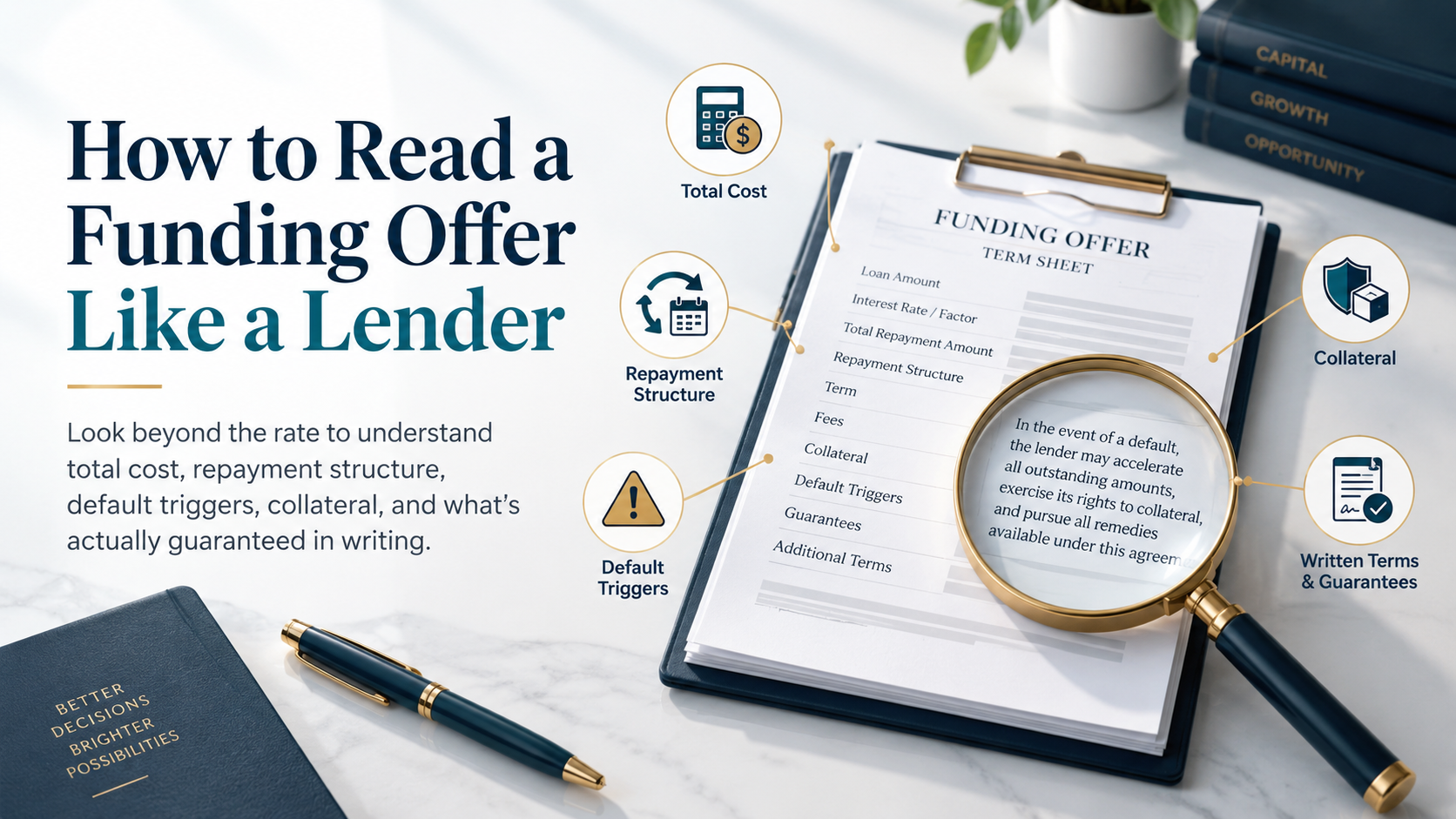
Most business owners read a funding offer the way they’d read a menu: scan for the number that matters most — usually the rate or the total amount — and decide from there. Lenders read the same document completely differently. They’re trained to look past the headline number to the structure underneath it, because that’s where the real cost and risk actually live. Learning to read an offer the way a lender does won’t just help you negotiate — it’ll help you spot the offers that look better than they actually are.
Start with the total cost, not the rate
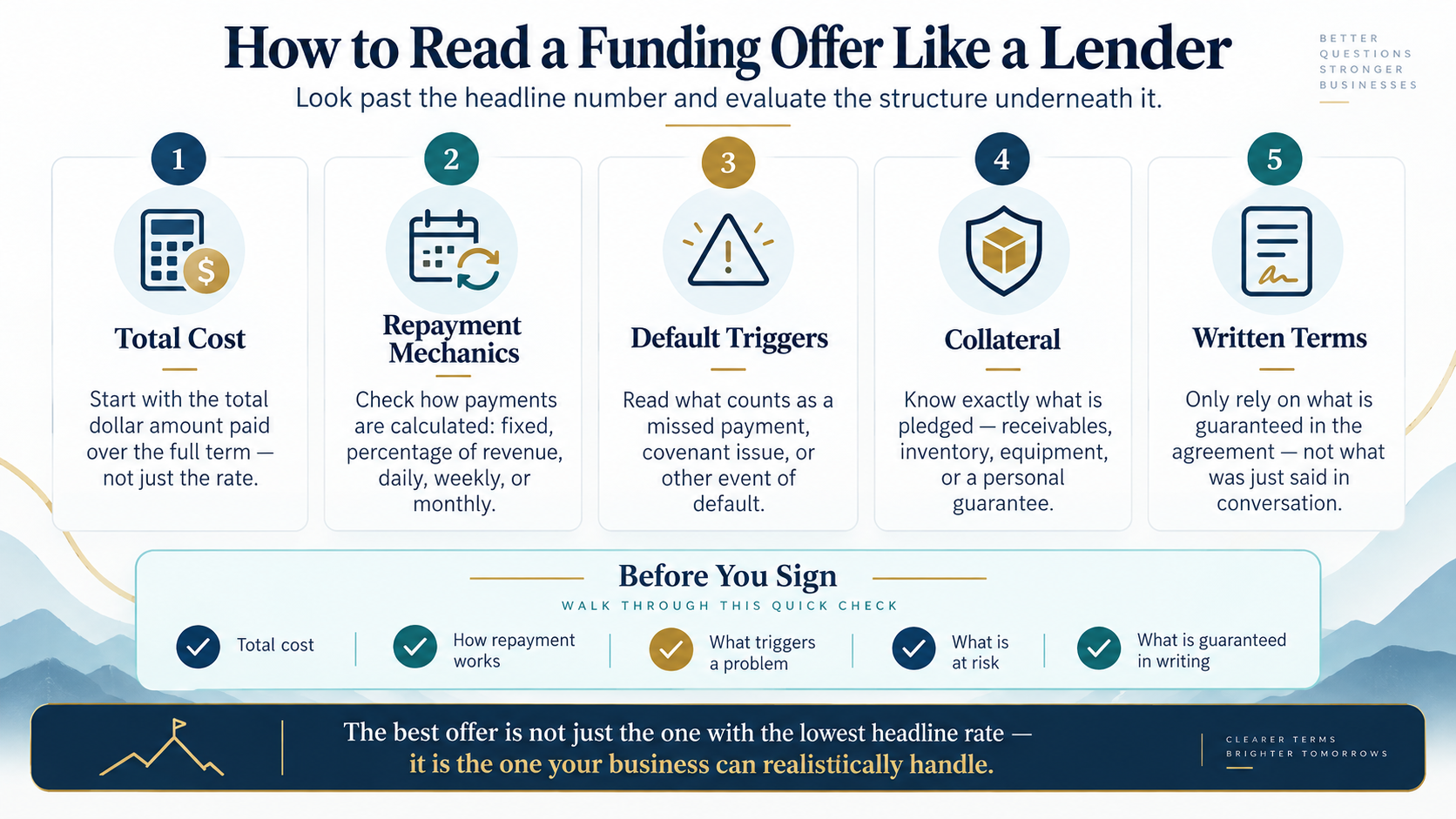
A lender evaluating risk cares about the full dollar amount that will change hands over the life of the deal — not the percentage used to describe it. Percentages can be structured in ways that make two very different offers look similar on the surface: an interest rate calculated on the original principal throughout the term looks smaller than one calculated on the declining balance, even when the actual dollars paid are close to identical. Before comparing anything else, convert every offer into one number: the total dollar amount you’ll pay if you complete the term as scheduled.
Then look at how repayment is actually calculated
Lenders don’t just note whether a payment is fixed or variable — they check exactly what it’s calculated against. A fixed monthly payment is straightforward. A percentage-of-revenue payment depends entirely on how “revenue” is defined in the contract, which can vary more than borrowers expect. A daily or weekly automatic withdrawal changes how a cash flow crunch actually feels, even if the total cost is identical to a monthly structure. The calculation method matters as much as the number itself, because it determines how the obligation behaves when your business has an unusually strong or unusually weak stretch.
Check what triggers a default, not just what a normal month looks like
Every offer reads well when you imagine your business performing exactly as planned. A lender’s real work is imagining the version where it doesn’t. What specifically counts as a missed payment? Is there a grace period? What financial thresholds, if any, does your business need to maintain, and what happens if it dips below them for one month versus several? This section of an offer is usually the least discussed and the most consequential — read it as carefully as the payment schedule itself.
Understand what’s actually collateral, and what happens to it
If any collateral is involved — receivables, inventory, equipment, or a personal guarantee — a lender wants precise clarity on what’s pledged and under what conditions it could be claimed. Borrowers sometimes skim this section because it feels like boilerplate. It isn’t. Knowing exactly what’s at risk, and under what specific circumstances, is a core part of evaluating whether an offer is genuinely favorable or just favorably worded.
Look for what’s flexible, and get it in writing
Lenders distinguish between what a sales conversation implies and what the contract actually guarantees. If you’ve been told early repayment saves money, or that a temporary revenue dip won’t trigger a covenant issue, or that the credit limit will grow as your business grows — check whether that flexibility is written into the agreement or simply mentioned in conversation. Verbal reassurances are not terms. If something matters to your decision, it needs to be in the document, not just in the pitch.
Why this reading habit matters more than any single number
The offer with the lowest headline rate isn’t automatically the best one — it’s the one where the total cost, the repayment mechanics, the default terms, the collateral exposure, and the actual flexibility all line up with what your business can realistically handle across a range of outcomes, not just the best-case one. Reading an offer the way a lender does means evaluating the whole structure, not just the number that was designed to catch your attention first.
A simple exercise before you sign anything
Take any offer in front of you and try to summarize it in five sentences: the total cost, how repayment is calculated, what triggers a problem, what’s at risk if it does, and what’s actually guaranteed in writing versus implied. If you can’t answer all five clearly from the document itself, that’s not a reason to panic — it’s a reason to ask the lender directly before you commit to anything.
FAQ
Is it reasonable to ask a lender to walk through these details with me directly? Yes — this is standard, expected due diligence, and a transparent lender should be able to answer every one of these questions clearly and without hesitation.
Does a lower total cost always mean a better offer? Not necessarily. Total cost matters most, but repayment structure and default terms determine how manageable that cost actually is for your specific business and cash flow pattern.
What if two offers look similar on every point above? At that stage, the decision often comes down to which lender you trust to be a reasonable partner if something unexpected happens — which is worth weighing alongside the numbers themselves.