
A lot of financing content is written with product-based businesses implicitly in mind — inventory, receivables from shipped goods, purchase orders from suppliers. Service businesses have a genuinely different balance sheet and cash flow pattern, and understanding those differences helps identify which financing structures actually apply, rather than trying to force-fit a product-business framework onto a fundamentally different kind of company.
What’s structurally different about a service business
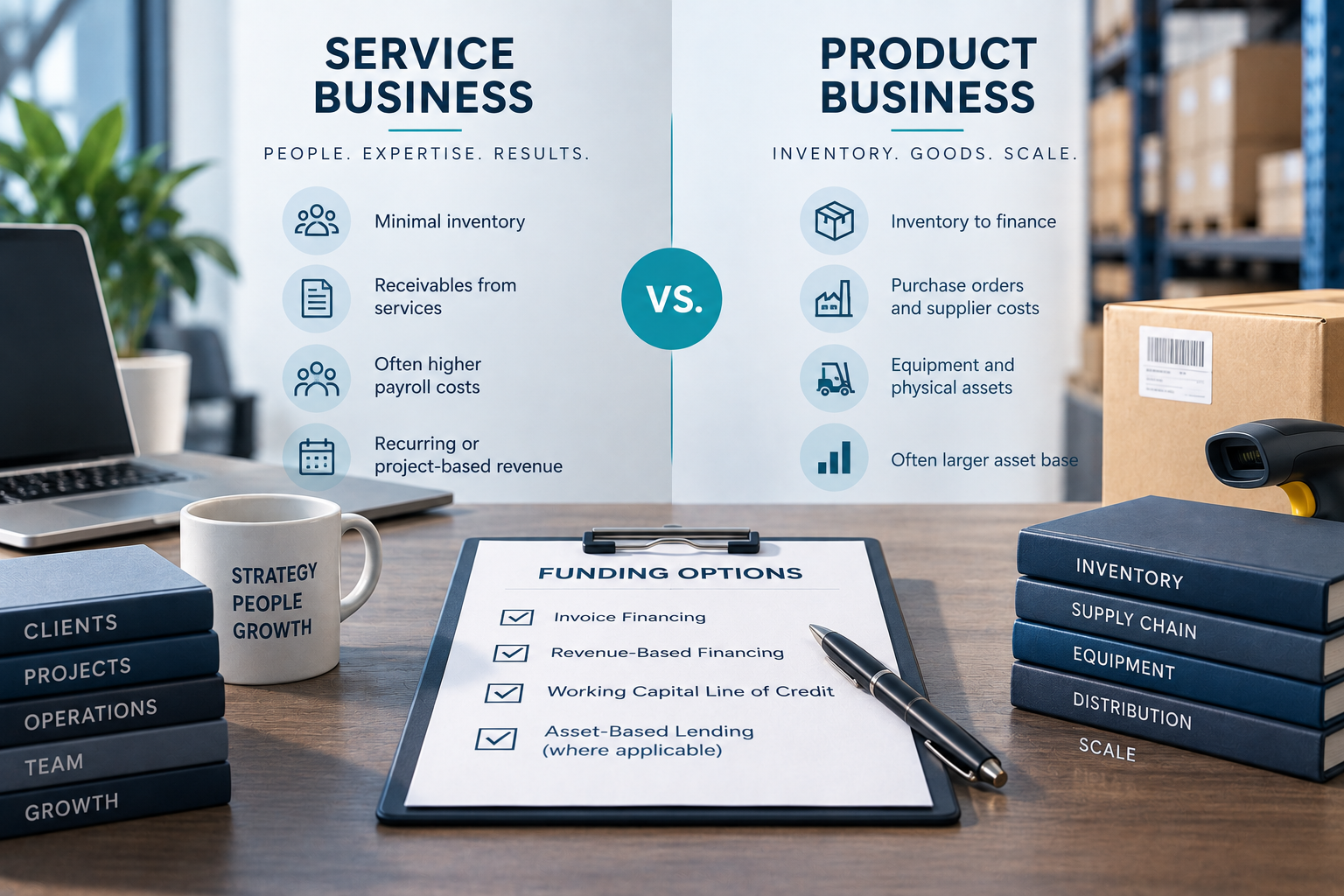
Service businesses typically carry minimal inventory and often have a smaller physical asset base than product businesses, which limits how much asset-based lending can offer in isolation. At the same time, service businesses often bill for completed work under payment terms similar to product businesses — meaning receivables and the cash flow gap they create are just as relevant, even without physical goods involved.
Where receivables-based structures still apply directly
Invoice financing and factoring work essentially the same way for a service business as for a product business — an invoice for completed consulting work, a completed project, or a delivered service is just as real a receivable as an invoice for shipped goods, and can be financed the same way if payment terms create a cash flow gap.
Where asset-based lending is more limited, but not irrelevant
A service business with minimal inventory or equipment will generally have a smaller asset-based borrowing capacity than a product business, since asset-based lending scales with the value of qualifying collateral. That said, service businesses with meaningful equipment — specialized machinery, technology infrastructure, vehicles — may still have real asset-based borrowing capacity worth evaluating, even if it’s not the primary financing tool for the business.
Why revenue-based financing often fits service businesses well
For service businesses with recurring or repeatable revenue — retainer-based consulting, subscription-based services, recurring contracts — revenue-based financing can be a strong fit, following the same underwriting logic that applies to SaaS businesses: recurring, predictable revenue supports a revenue-based structure well, independent of physical assets or inventory.
What working capital lines of credit typically fund for service businesses
Payroll is often the single largest recurring expense for a service business, since the “product” being delivered is largely people’s time. A working capital line of credit that smooths out the gap between when payroll and other operating costs are due and when client payments arrive is frequently one of the most directly useful financing tools for a service business’s day-to-day operations.
A common mistake: assuming limited options because of no inventory
Some service business owners assume their financing options are inherently limited because they don’t have inventory or significant physical assets to offer as collateral. In practice, the right combination of invoice financing, revenue-based financing where applicable, and a working capital line of credit often covers a service business’s needs just as effectively as asset-based lending covers a product business’s needs — the toolkit is different, not smaller.
Questions to clarify your own service business’s fit
- Do you bill on completed milestones or ongoing retainers, and does that create a recurring cash flow gap worth financing?
- Is your revenue recurring and predictable enough to support a revenue-based structure, or more project-based and variable?
- Do you carry any meaningful equipment or technology infrastructure that could support even a modest asset-based facility?
- Is payroll or another recurring operating cost your primary working capital challenge?
FAQ
Can a service business with no physical assets at all still get financing? Yes — invoice financing, revenue-based financing, and working capital lines of credit are generally underwritten independent of physical asset ownership, making them accessible to asset-light service businesses.
Does client concentration matter more for a service business than a product business? It can be a more pronounced factor, since service businesses sometimes have fewer, larger client relationships than product businesses with broader customer bases — worth being transparent about with a lender rather than assuming it’s not relevant.
Is revenue-based financing only for technology or SaaS service businesses? No — any service business with sufficiently recurring or predictable revenue, regardless of industry, can be a reasonable candidate, though the underwriting will look closely at the actual consistency of that revenue.