The idea behind revenue-based financing is easy to grasp in one sentence: you repay a percentage of revenue instead of a fixed monthly amount. But the actual mechanics — how the percentage is calculated, what happens across a strong month versus a slow one, and how you know when you’re done — deserve a closer look before you’re relying on this structure to fund your business.
The basic mechanism
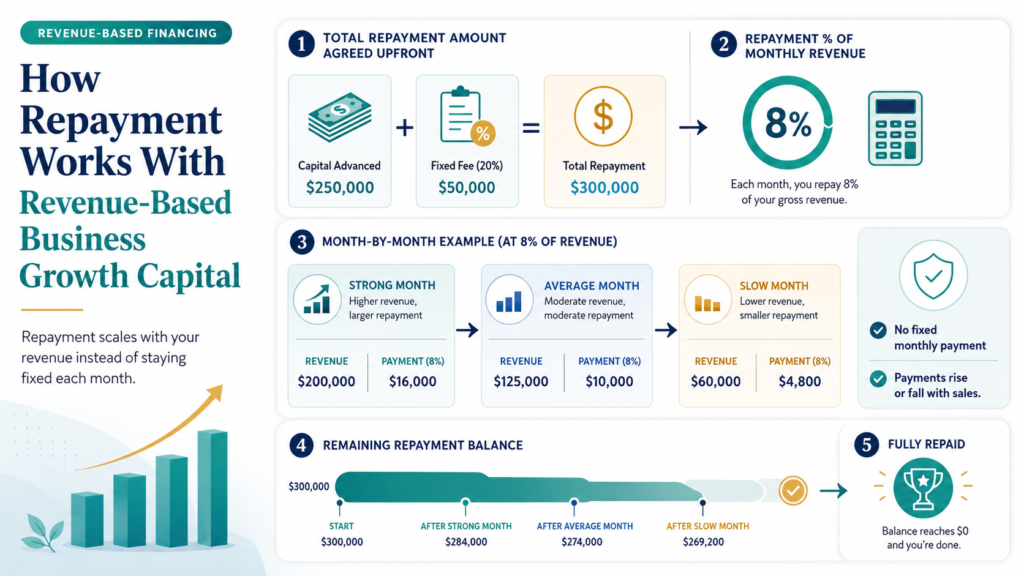
When you’re approved for revenue-based financing, you agree on two key numbers upfront: the total repayment amount (the capital advanced, plus a fixed fee), and the percentage of monthly revenue that will go toward repayment. Each month, you calculate that percentage against your actual revenue for the period, and that amount is remitted toward the total repayment balance. This continues until the full agreed repayment amount has been reached — at which point the obligation is complete, regardless of how many months it took to get there.
Working through the math with real numbers
Imagine a business receives revenue-based capital with a total repayment amount agreed upfront, and a repayment percentage applied to monthly revenue. In a month where revenue comes in strong, a larger dollar amount is remitted, and the business moves closer to the total repayment amount faster. In a slower month, a smaller dollar amount is remitted — the payment shrinks in step with revenue, rather than staying fixed regardless of how the month actually went.
This is the core difference from a traditional loan: a fixed monthly payment doesn’t care whether your revenue was strong or weak that month. A revenue-based payment does.
Why the total repayment amount matters more than people initially realize
Because the total repayment amount is fixed upfront, how quickly you repay it directly affects your effective cost of capital. A business that repays quickly, because revenue is strong, ends up paying that same fixed amount over a shorter period of time — which means a higher annualized cost than a business that takes longer to repay. This isn’t a hidden flaw in the structure; it’s simply how a fixed-total, revenue-scaled repayment mechanism works. It’s worth modeling out what your repayment timeline might realistically look like under both a strong-revenue and a conservative-revenue scenario, so the total cost isn’t a surprise either way.
What counts as “revenue” for repayment purposes
This detail varies by lender and is worth clarifying before you sign: does “revenue” mean total gross revenue, or revenue net of certain deductions? Are there any exclusions — for example, one-time non-operating income? Getting a precise, written definition of how revenue is calculated for repayment purposes avoids disputes or surprises down the line, especially in a month with unusual revenue activity.
What happens in a genuinely slow month
A key advantage of this structure is that a slow month doesn’t create the same strain that a fixed loan payment would — your payment scales down along with revenue, rather than remaining constant regardless of how the month actually went. That said, most agreements include some understanding of what happens in an extended downturn, not just a single slow month — it’s worth understanding whether there’s a minimum payment floor, or what protections and obligations exist if revenue declines significantly for a sustained period, rather than just one off month.
Tracking your progress toward full repayment
Because the total repayment amount is fixed, you can track exactly how much remains at any point — a straightforward calculation of the total agreed amount minus what’s been remitted so far. This gives you real visibility into how much longer the obligation will likely continue, based on your recent revenue trend, which is useful for cash flow planning even though the exact end date isn’t fixed at the outset the way it would be with a traditional loan term.
Early repayment
Some revenue-based structures allow you to repay the remaining balance early — potentially at a discount to the full remaining amount, depending on the lender — while others don’t offer this option. If minimizing total cost matters to you and there’s a reasonable chance your business could generate a lump sum to pay down the balance early (from a strong quarter, a capital raise, or another source), it’s worth confirming this term before signing, since it directly affects your total cost under a best-case scenario.
FAQ
Is there a maximum time limit to repay revenue-based financing? This varies by lender and agreement — some structures include an outside date by which the full amount must be repaid regardless of revenue performance, which is worth understanding upfront, particularly for businesses with genuinely unpredictable revenue.
How is the repayment percentage determined? This is negotiated as part of the offer and depends on your revenue history, the total amount financed, and the specific lender’s underwriting — it’s not a fixed industry-standard number, which is part of why comparing multiple offers matters.
Do I need to submit revenue reports manually each month, or is this automated? This depends on the lender and how your business’s financial systems are connected — many revenue-based financing structures use connected banking or accounting data to calculate repayment automatically, reducing manual reporting burden.