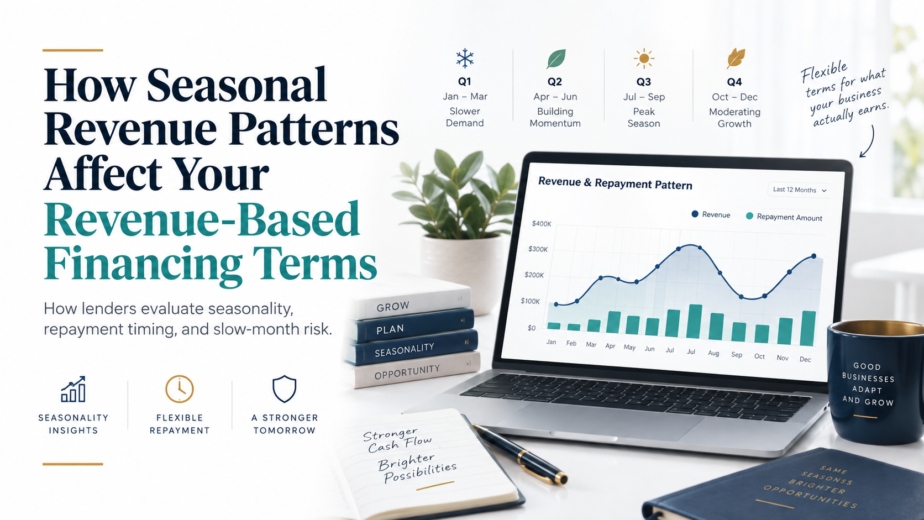
E-commerce businesses generate some of the cleanest, most granular revenue data of any business type — daily sales figures, clear seasonal patterns, and detailed channel-level performance. That data happens to be exactly what makes revenue-based financing work well, which is part of why it’s become such a common financing tool heading into the busiest quarter of the e-commerce calendar.
Why e-commerce revenue data is well-suited to this structure
Revenue-based financing depends on a lender’s ability to confidently model how a business’s revenue is likely to behave over the repayment period. E-commerce businesses typically have detailed historical data — daily and monthly sales, clear year-over-year seasonal patterns, channel-by-channel performance — that supports more precise underwriting than a business with less granular reporting. This often translates into a smoother, faster underwriting process specifically for e-commerce applicants.
What Q4 specifically changes about the calculation
For most e-commerce brands, Q4 represents a disproportionate share of annual revenue, concentrated into a few months. That means the repayment math for revenue-based financing taken out ahead of Q4 looks different than it would for a facility taken out during a slower period — a much larger share of repayment is likely to happen in a compressed window, rather than spread evenly across the year. Understanding this concentration, and confirming the offer’s structure accounts for it realistically, is worth doing explicitly before committing.
What this capital typically funds heading into Q4
Inventory ahead of demand. The most common use, ensuring popular products don’t run out of stock during the highest-revenue period of the year.
Paid advertising and marketing spend. With a clear, historically grounded return on ad spend, funding a marketing push ahead of Q4 with revenue-based capital can make sense — provided the calculation genuinely holds up at the scale you’re planning to spend, a topic worth modeling carefully rather than assuming linear returns.
Fulfillment and logistics capacity. Additional warehousing, staffing, or shipping capacity to handle a larger volume of orders without service quality slipping during the season that matters most for customer retention.

Why timing the application matters as much as the decision itself
Revenue-based financing underwriting takes real time, and Q4 preparation timelines are unforgiving — inventory has to be ordered and received well before the season, and marketing campaigns need lead time to ramp up effectively. Starting the financing conversation in late summer, rather than waiting until Q4 itself, gives you the full benefit of the capital rather than receiving it too late to meaningfully affect the season it was meant to fund.
What to watch for in a Q4-specific offer
Given how concentrated e-commerce revenue can be around Q4, pay close attention to how the offer defines the repayment period and whether it accounts for your specific seasonal concentration. An offer structured around an assumption of even revenue distribution across the year may not accurately reflect how a heavily Q4-weighted e-commerce business will actually experience repayment.
Using last year’s Q4 data honestly
The strongest applications use last year’s actual Q4 performance as a grounded basis for this year’s projections, adjusted for known changes — new products, discontinued lines, shifts in advertising strategy — rather than an optimistic extrapolation untethered from historical results. Lenders generally respond well to this kind of grounded, honest projection, and it also serves your own planning better than an overly optimistic internal forecast would.
FAQ
Does revenue-based financing work for e-commerce brands selling primarily through a single marketplace channel? Generally, yes — single-channel revenue history is still usable for underwriting, though lenders may also want to understand any platform-specific risks, such as dependency on a single marketplace’s policies or algorithm.
How far ahead of Q4 should an e-commerce brand start this conversation? Given inventory and marketing lead times, many e-commerce brands begin the financing conversation in the summer months, well ahead of the Q4 buildup itself.
Does a single very strong Q4 skew future underwriting in a way that hurts me later? Lenders generally look at the full seasonal pattern across multiple periods, not a single strong quarter in isolation, though it’s worth discussing directly how your specific revenue history will be evaluated.