A traditional lender looking at a SaaS company burning cash to fuel growth might see a business that isn’t ready for debt. A venture debt lender looking at the same company often sees something different: strong annual recurring revenue, healthy growth, and a clear, well-understood path in the venture ecosystem — even without current profitability. Understanding why venture lenders weight these factors differently explains both why venture debt exists as a category and why it’s become such a common tool for SaaS companies specifically.
Why traditional underwriting doesn’t fit high-growth SaaS
Conventional lending is built around a company generating consistent profit or at least positive cash flow, since that’s traditionally been the clearest signal of ability to repay. Many strong, healthy SaaS companies deliberately don’t optimize for near-term profitability — they reinvest aggressively into growth because the long-term value of a larger, stickier customer base outweighs near-term profit, especially with strong retention and expanding revenue per customer over time. A lender that only underwrites against current profitability would systematically miss financing many of the strongest companies in this category.
What ARR actually signals to a lender
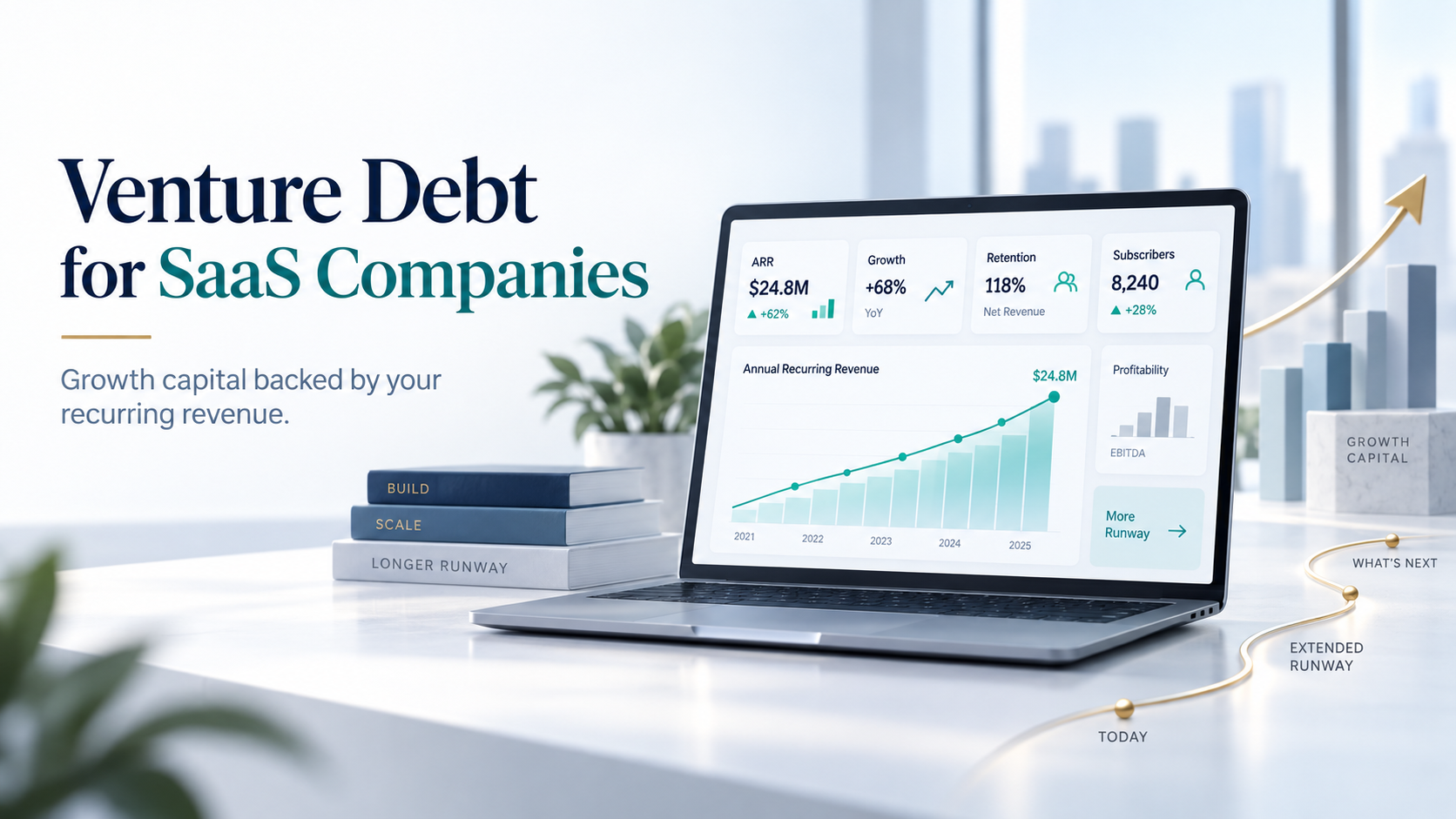
Annual recurring revenue represents a more durable, predictable base than one-time sales — a dollar of ARR implies not just current revenue, but revenue a lender can reasonably expect to continue absent unusual churn. For a venture lender, ARR growth combined with reasonable retention is often a stronger signal of underlying business health than current profitability, because it reflects both the size and the durability of the business’s core revenue engine, independent of how aggressively the company is currently reinvesting that revenue into growth.
Why growth rate matters alongside ARR itself
Two companies with identical current ARR can represent very different risk profiles depending on their growth trajectory. A company with steadily accelerating ARR growth is telling a different story than one with flat or slowing growth, even at the same current revenue level. Venture lenders typically weight growth rate heavily, since it speaks directly to what the company’s revenue — and therefore its ability to service debt — is likely to look like over the loan’s term, not just where it stands today.

The role of institutional equity backing
Venture debt is generally extended to companies that have already raised institutional equity, and that backing does real underwriting work beyond just providing cash. It signals that sophisticated investors have already done diligence on the company’s market, team, and trajectory, and it typically means there’s a reasonable expectation of future equity rounds that could, if needed, support the company through a rough patch — all of which factors into a venture lender’s confidence, separate from the company’s current profitability.
What SaaS-specific metrics matter beyond ARR and growth rate
Net revenue retention (whether existing customers are expanding or contracting their spend over time), gross margin, and customer concentration all factor into how a venture lender evaluates a SaaS company specifically. A company with strong ARR growth but high customer concentration in a small number of large accounts, for example, carries a different risk profile than one with the same ARR spread across a broad, diversified customer base — worth understanding how your own metrics are likely to be read before entering a venture debt conversation.
Why this doesn’t mean profitability is irrelevant
None of this means profitability doesn’t matter at all — a lender still wants a credible path to eventual profitability or a future equity round that would support continued operations, even if that path isn’t fully realized yet. The distinction is that venture debt underwriting for SaaS companies weights current profitability much less heavily than traditional lending would, in favor of metrics that better predict the company’s trajectory: ARR, growth rate, retention, and the strength of its equity backing.
FAQ
Does my SaaS company need to be profitable to qualify for venture debt? Generally, no — venture debt is specifically structured around companies that may not yet be profitable but have strong ARR, growth, and institutional equity backing.
What ARR growth rate is considered strong enough for venture debt? This varies by lender and by the broader market context at the time, so there’s no single universal threshold — it’s worth discussing your specific metrics directly with a lending partner rather than benchmarking against a general rule of thumb.
Does high customer concentration disqualify my company from venture debt? Not automatically, but it is a factor lenders weigh carefully, since it affects how resilient your ARR is to the loss of any single customer.