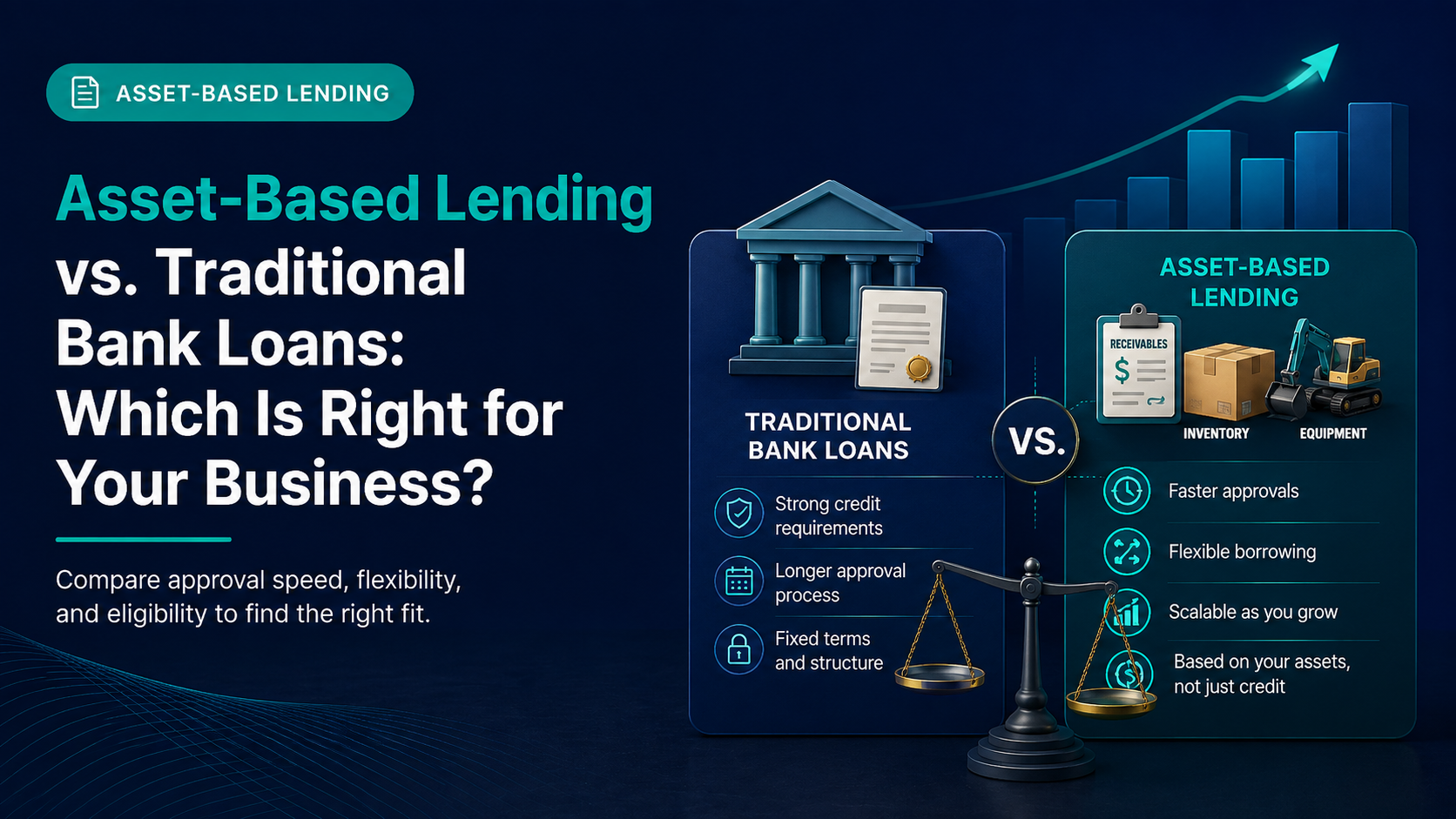
When most business owners think about financing, a bank loan is usually the first option that comes to mind — it’s familiar, and for businesses that qualify, it can offer competitive rates. But “familiar” and “best fit” aren’t always the same thing. Asset-based lending solves a different problem than a traditional bank loan does, and understanding that difference matters more than comparing headline interest rates.
The core difference: what each lender is actually evaluating
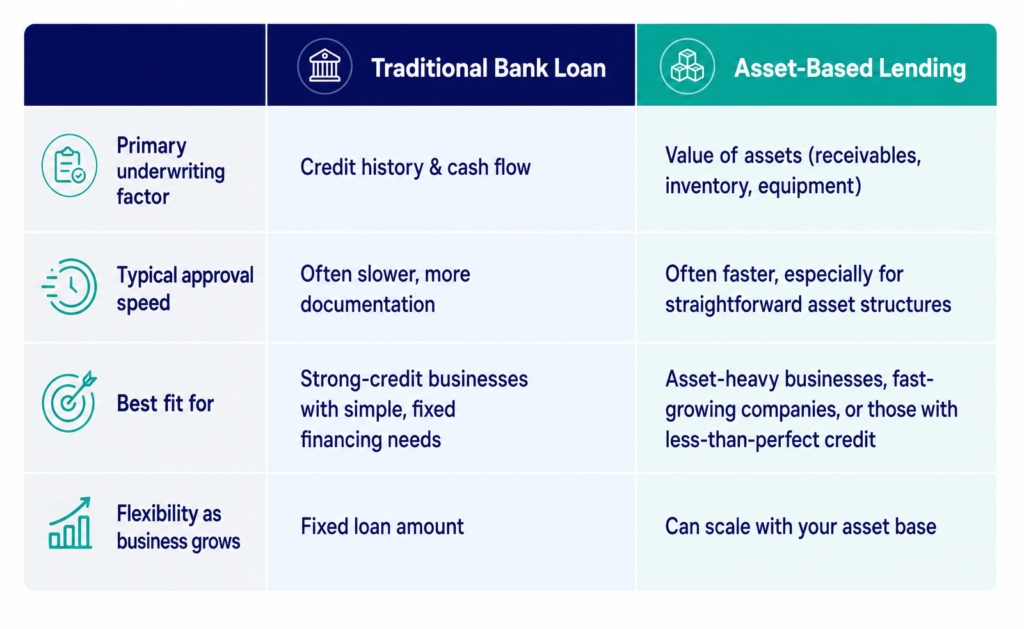
A traditional bank loan is underwritten primarily on your business’s overall creditworthiness: time in business, credit history, cash flow consistency, and often a strong balance sheet with limited existing debt. The bank is making a bet on your business as a whole.
Asset-based lending shifts that evaluation toward a specific question: what is the value of the assets you’re offering as collateral, and how reliably can that value be verified? Accounts receivable, inventory, and equipment become the primary basis for how much you can borrow — which changes who qualifies and how quickly.

Where bank loans tend to win
- Rate, for businesses with strong, clean credit. A well-qualified borrower with a long operating history and clean financials can often secure competitive fixed rates through a bank.
- Simplicity for straightforward needs. If your financing need is simple — a fixed amount, a fixed term, predictable use — a bank term loan can be a clean, well-understood structure.
Where asset-based lending tends to win
- Speed and flexibility. Because the underwriting leans on verifiable asset value rather than an extensive credit and cash-flow review, asset-based lending can often move faster than the traditional bank underwriting process.
- Accessibility for asset-rich, credit-imperfect businesses. A business with strong inventory or receivables but a less-than-pristine credit history, a short operating history, or a recent rough patch may struggle to qualify for a bank loan sized to its actual needs — but still have plenty of asset value to borrow against.
- Scalability. As your receivables or inventory grow, the amount available through an asset-based facility can grow with it. A bank term loan is fixed at the amount and doesn’t adjust as your business scales.
- Larger facilities for asset-heavy businesses. For manufacturers, distributors, and wholesalers carrying significant inventory or equipment, an asset-based facility can sometimes unlock more capital than a bank would extend based on cash flow alone.
A side-by-side way to think about it
It doesn’t have to be either/or
Some businesses use both at different points — a bank relationship for long-term, predictable needs, and an asset-based facility for the flexibility to respond to growth or seasonal swings. The point isn’t that one is universally better than the other; it’s that they solve different problems, and the right choice depends on what your business actually needs capital for and how quickly you need it.
This is precisely why comparing structures side by side — rather than defaulting to whichever lender you already have a relationship with — tends to produce a better outcome than assuming one type of financing is automatically right.
FAQ
Is asset-based lending more expensive than a bank loan? It depends on the specific offer and your business’s qualification profile. Asset-based lending isn’t inherently more expensive — it’s a different underwriting approach, and the actual cost depends on the lender, the asset type, and your business’s specifics. Comparing real offers side by side is the only reliable way to know.
Can I get asset-based lending if a bank already turned me down? Often, yes. A bank decline based on credit history or cash flow consistency doesn’t necessarily reflect the value of your assets — which is the primary factor asset-based lenders evaluate.
Do I need to already have a business bank account relationship to qualify for asset-based lending? No — asset-based lending is evaluated independently based on your business’s assets, not your existing banking relationships.