PO financing works differently than most business financing in one important way: qualification depends far more on the strength of a specific order than on your business’s overall credit profile. That’s good news if your credit history isn’t perfect, but it also means the application process looks a little different than what you might expect. Here’s what actually goes into qualifying.
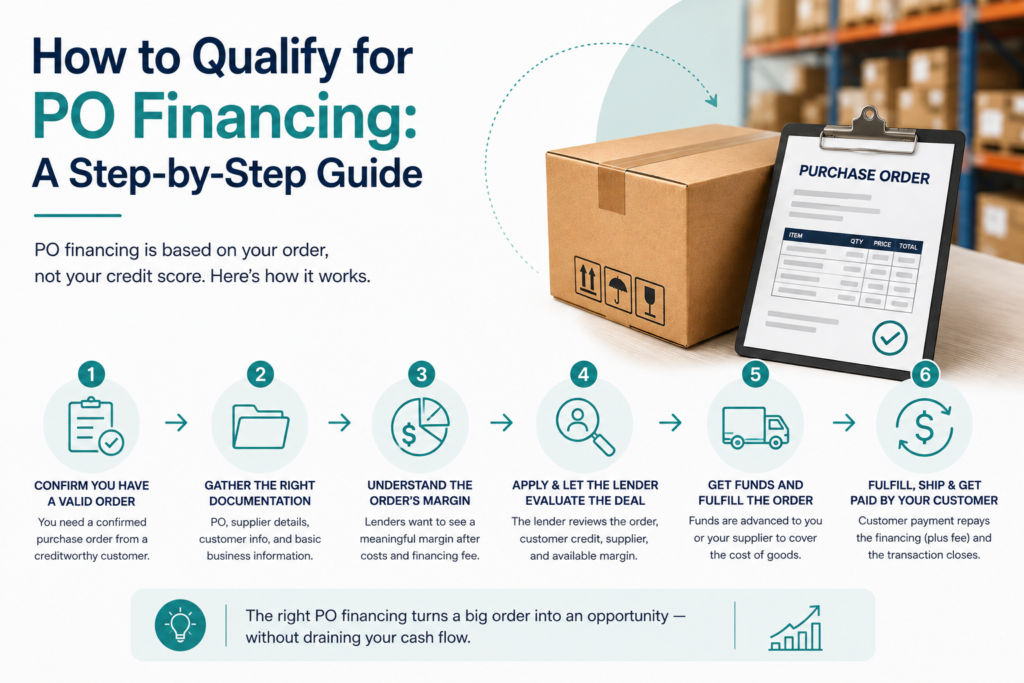
Step 1: Confirm you have what PO financing actually requires
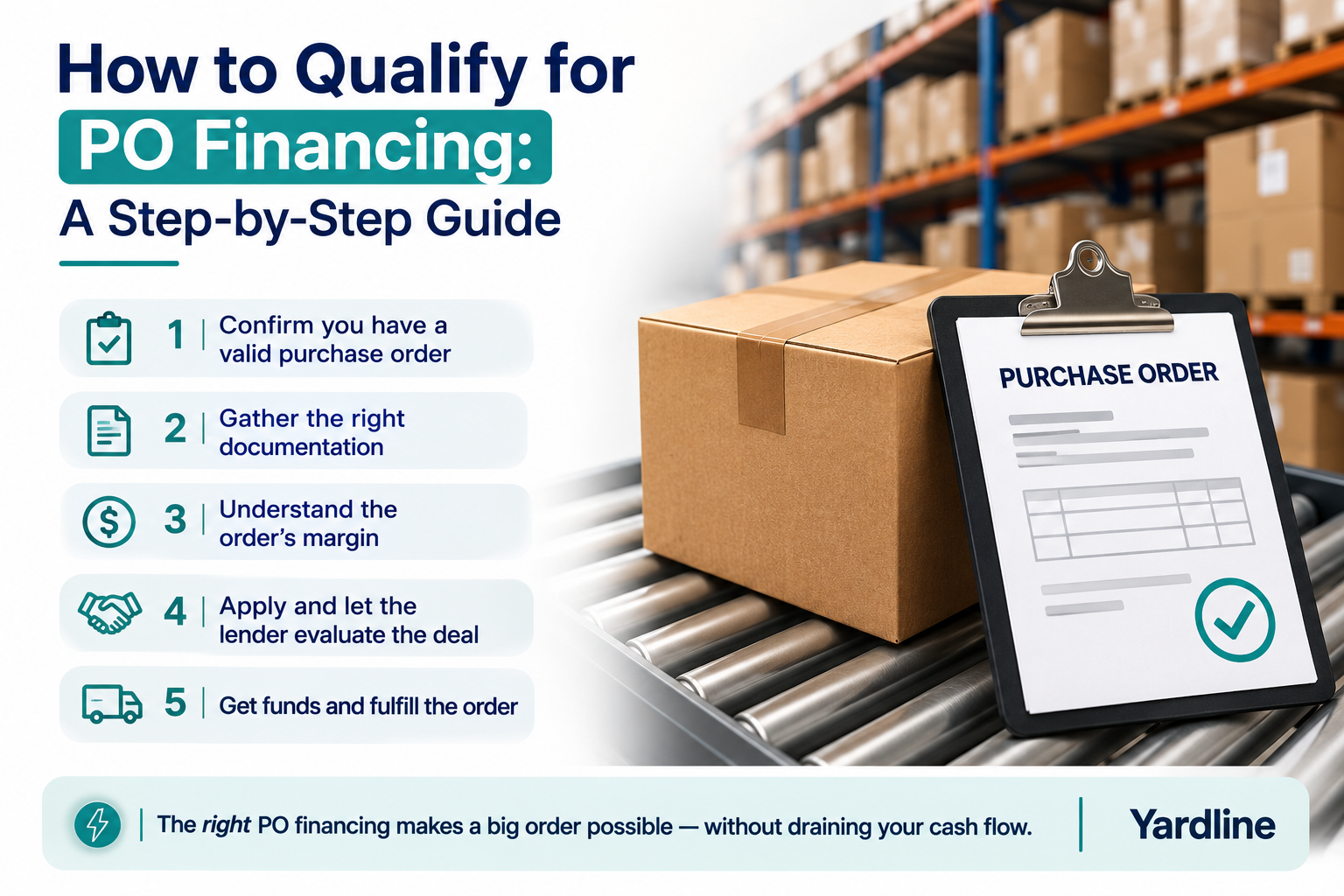
Before applying, make sure your situation genuinely fits the product. You need:
- A confirmed purchase order from a customer — not a verbal agreement or an anticipated order, but an actual, documented PO
- A creditworthy customer behind that order — an established business with a reasonable payment history, since the lender is ultimately relying on that customer paying
- A clear cost structure for fulfilling the order — you know what it will cost to produce or acquire the goods, and what margin remains after that cost and the financing fee
If any of these pieces are missing — no confirmed order yet, an unproven or unclear customer, or an order too small to justify the financing structure — PO financing may not be the right fit yet, though it’s worth having a direct conversation with a funding specialist about timing and alternatives.
Step 2: Gather the documentation lenders will actually review
- The purchase order itself, in full
- Information about your supplier, including their pricing for the goods needed
- Basic information about your customer — how established they are, and ideally some indication of payment history if you have prior transactions with them
- Your business’s basic information: time in operation, industry, and general financial picture
Because PO financing is underwritten heavily around the specific transaction, this documentation tends to be more transaction-focused than the extensive financial history a traditional bank loan application would require.
Step 3: Understand how the order’s margin factors in
Lenders generally want to see that a meaningful margin remains after accounting for the cost of goods and the financing fee — a razor-thin margin order leaves little room for the fee itself, which can make the deal less attractive to structure. This doesn’t mean you need an enormous margin, but it’s worth calculating the real numbers on your specific order before applying, so you have a realistic sense of whether the economics work.
Step 4: Apply and let the lender evaluate the transaction
Once you submit your application and documentation, the lender evaluates the strength of the order itself — the customer’s creditworthiness, the clarity of the purchase order terms, your supplier relationship, and the margin available. This is a fundamentally different evaluation than a traditional loan review, which is part of why PO financing can sometimes be accessible to businesses that might not qualify for other types of financing based on credit history alone.
Step 5: Funds go toward fulfilling the order
Once approved, the financing is typically directed to your supplier — either paid directly by the lender or advanced to you to pay your supplier — covering the cost of producing or acquiring the goods needed for the order.
Step 6: Fulfill, ship, and let the customer’s payment close the loop
Once your supplier delivers and you fulfill the order, your customer’s eventual payment repays the financing, along with the associated fee, and the transaction closes.
What can strengthen your application
- An established relationship with your customer, even informally, since prior successful transactions with the same customer can support the lender’s confidence in eventual payment
- A clear, itemized cost breakdown for fulfilling the order, rather than a rough estimate
- A reliable, established supplier relationship, since supplier reliability affects the lender’s confidence that the order can actually be fulfilled as planned
What can work against your application
- An order from a brand-new, unproven customer with no verifiable payment history
- A purchase order with vague or non-binding terms
- A margin too thin to comfortably absorb the financing fee
- Supplier relationships that are new or unreliable, introducing execution risk into the transaction
FAQ
Do I need a minimum order size to qualify for PO financing? This varies by lender, and there’s no single universal threshold — it’s worth discussing your specific order directly with a funding specialist rather than assuming a fixed minimum.
Can I use PO financing if this is my first order from a particular customer? It’s possible, but a new, unproven customer relationship can make underwriting more cautious than an established one with a payment track record. It’s not automatically disqualifying, but it’s a factor worth being upfront about.
How quickly can PO financing be arranged once I have a confirmed order? Timelines vary by lender and the complexity of the specific transaction, but because PO financing is underwritten around a single order rather than a full business review, it can often move faster than traditional financing — a funding specialist can give you a realistic estimate based on your specific situation.