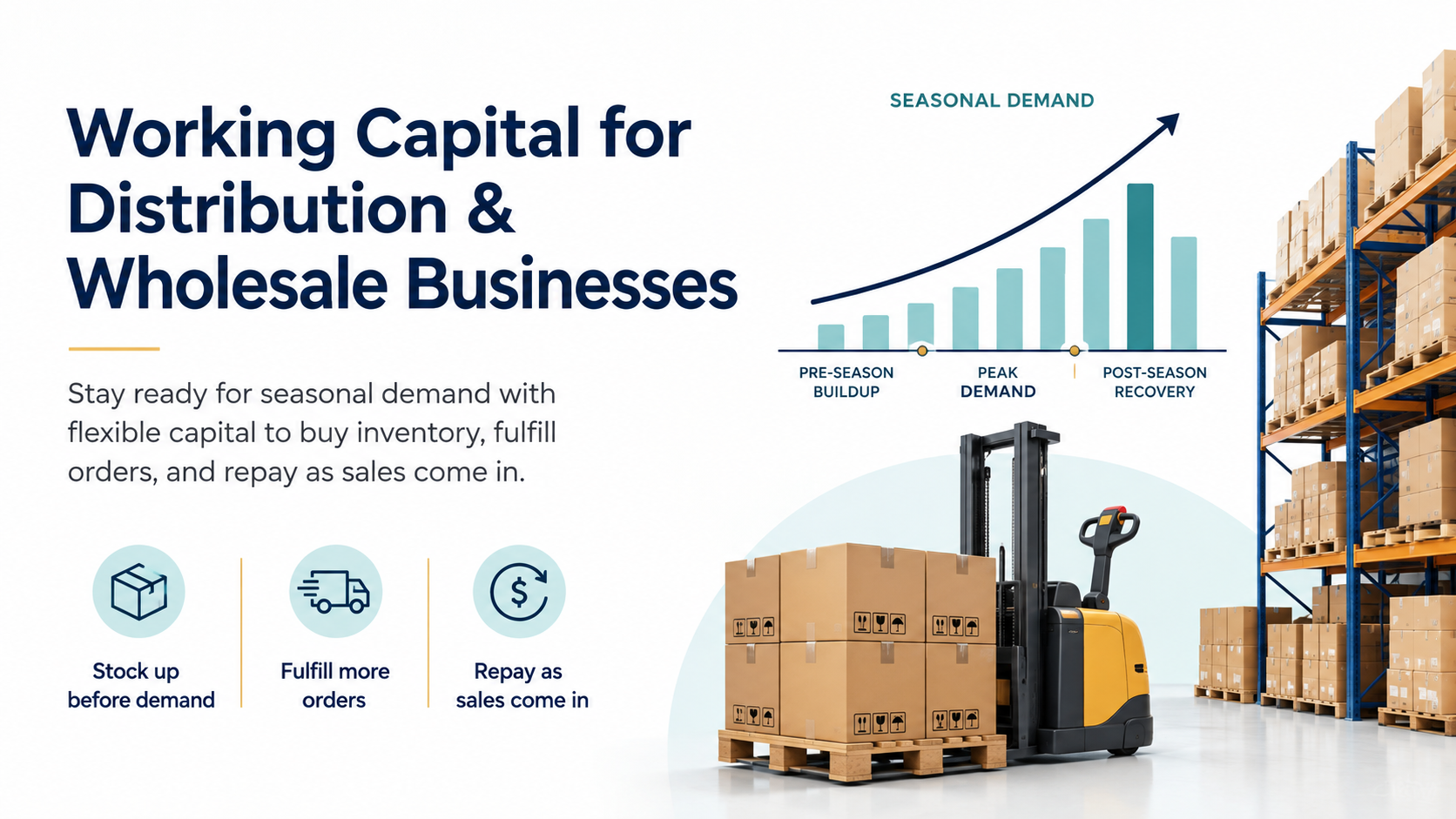
Distribution and wholesale businesses live and die by timing. Order too little inventory ahead of a demand spike, and you miss sales you’ll never get back. Order too much without the cash to comfortably carry it, and working capital gets tied up in a way that strains everything else the business needs to run. A working capital line of credit exists to remove that tension — giving you access to capital when demand requires it, without forcing you to either overextend cash reserves or underprepare for the season ahead.

Why seasonality hits distribution businesses especially hard
Unlike a service business with relatively steady monthly costs, a distributor’s biggest cash outlays — inventory purchases — often need to happen well before the corresponding sales revenue arrives. If your peak season is Q4, you may need to significantly build up inventory in Q2 and Q3, months before that inventory converts into cash. During that buildup window, cash is going out steadily while revenue hasn’t caught up yet — exactly the kind of gap that strains a business relying purely on its own cash reserves.
Why a line of credit fits this pattern better than a fixed loan
A traditional term loan gives you a fixed amount, all at once, with a fixed repayment schedule starting immediately — regardless of whether you actually need the full amount right away or whether your revenue is positioned to support repayment yet. A revolving line of credit works differently: you draw what you need, when you need it, and you’re only paying for what you’ve actually drawn. That structure maps naturally onto a seasonal business — draw more heavily during the inventory buildup period, repay as sales convert that inventory into cash, and the available credit resets for the next cycle.
A practical seasonal cycle, mapped to financing needs
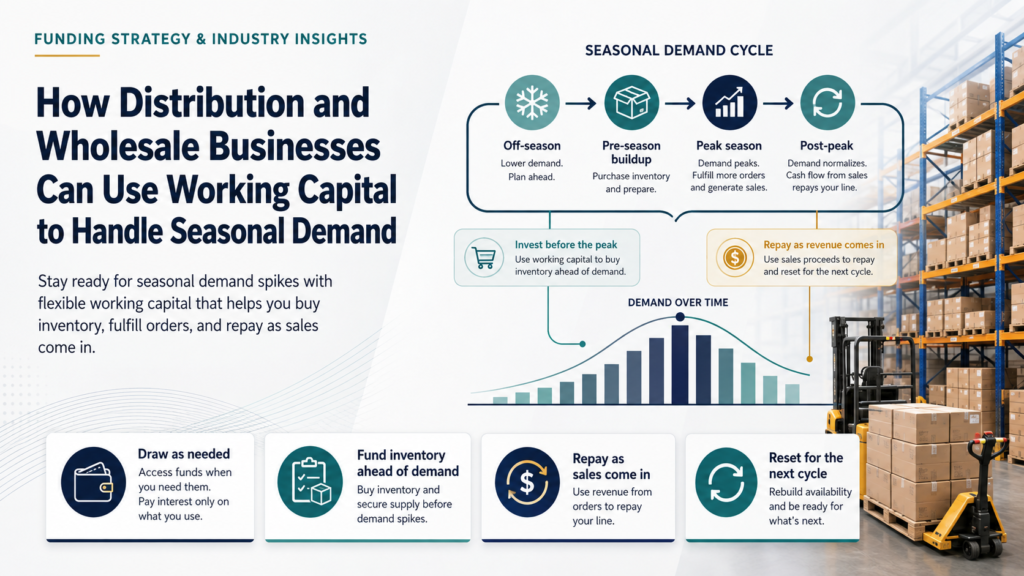
- Off-season (lower demand): Cash flow is relatively stable, credit utilization is typically lower, and this is a good window to plan next season’s inventory needs and financing strategy.
- Pre-season buildup: Inventory purchases ramp up ahead of anticipated demand, well before the corresponding revenue arrives. This is typically when draws on a working capital line increase the most.
- Peak season: Sales convert inventory into revenue, and repayment on the line typically accelerates as cash comes in.
- Post-peak: The line resets as it’s paid down, ready for the next cycle — whether that’s the next season or an unexpected demand spike.
Beyond seasonality: handling demand spikes you didn’t fully predict
Even with good planning, distribution businesses regularly face demand that exceeds forecasts — a new retail account that orders more than expected, a competitor’s supply issue that sends new customers your way, a product that catches on faster than projected. A working capital line of credit that’s already in place means you can respond to that opportunity immediately, rather than starting a financing application from scratch at the exact moment you need capital fastest.
Combining working capital with transaction-specific financing
For distribution businesses, a working capital line often works alongside more transaction-specific products. A large single order that exceeds what you’d comfortably draw from a general line might be better suited to PO financing, sized specifically to that order. Meanwhile, the working capital line continues to cover the broader, ongoing rhythm of the business — payroll, smaller routine inventory purchases, and operational flexibility that doesn’t map to any single transaction.
What to evaluate in a working capital line of credit
- Draw flexibility: Can you draw and repay repeatedly as needed, or is it closer to a one-time facility?
- Cost when undrawn: Some lines charge a fee just for having the facility available, even if you’re not currently drawing on it — worth understanding upfront.
- How the credit limit is determined and whether it can grow: Does the available credit scale as your business grows, or is it fixed at the original amount?
- Repayment terms on amounts drawn: How is repayment structured once you’ve drawn against the line?
FAQ
Do I need to draw on the full line immediately after approval? No — a revolving line of credit is designed for you to draw only what you need, when you need it, rather than taking the full amount upfront regardless of immediate need.
Can my available credit limit grow as my business grows? This depends on the specific facility and lender — some lines are structured to reassess and potentially increase available credit as your revenue or asset base grows, which is worth discussing directly if scalability matters to your business.
Is a working capital line of credit the same as asset-based lending? They can overlap — some working capital lines are secured by business assets, functioning similarly to an asset-based facility, while others are structured differently. It’s worth understanding the specific structure of any offer rather than assuming all lines of credit work identically.