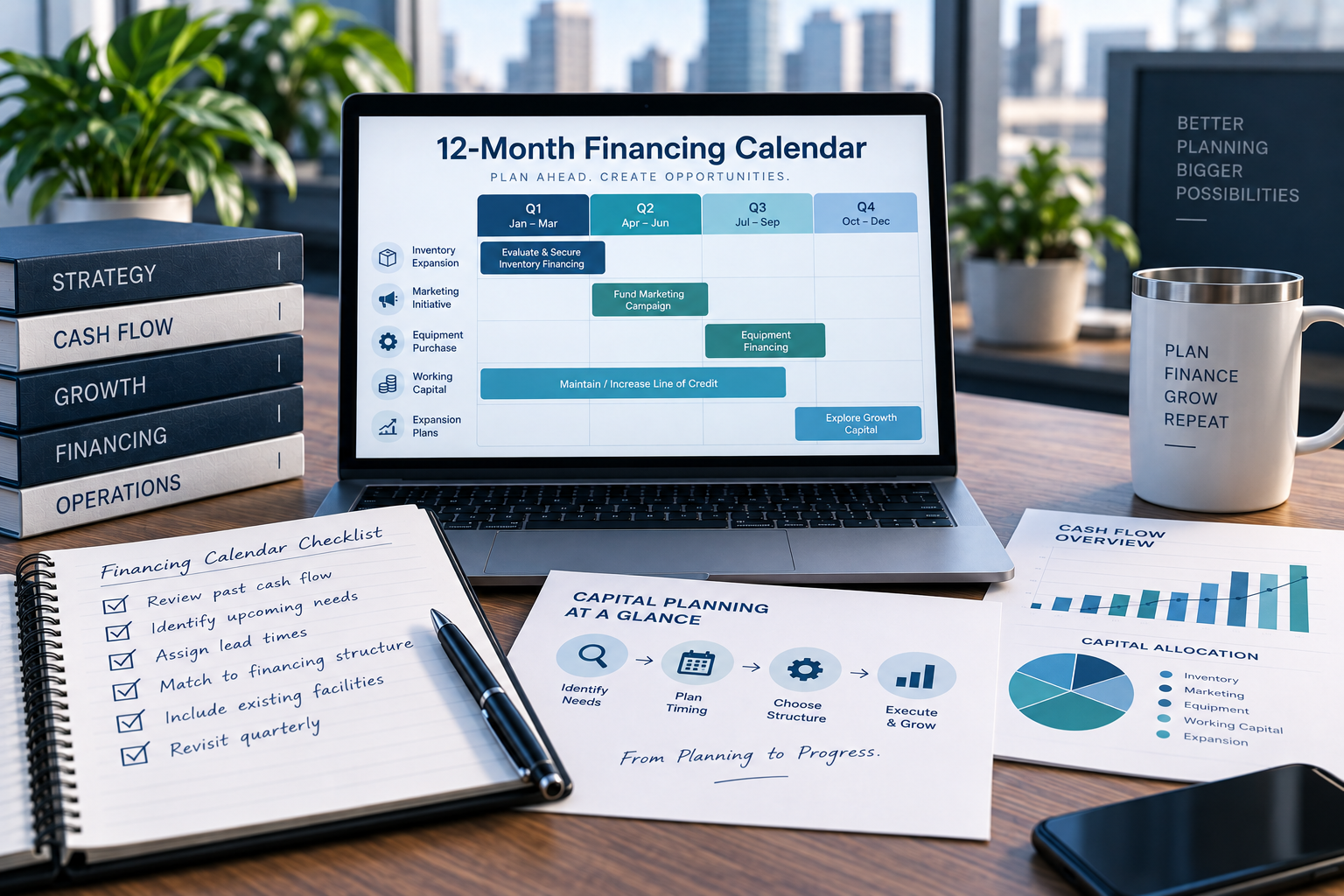
Most businesses treat financing as something that happens when a need becomes urgent — a cash crunch, a big order, an unexpected expense. A smaller number of businesses treat it as something to plan a year in advance, the same way they’d plan hiring or inventory. The second approach consistently produces better terms, less stress, and fewer rushed decisions, and it starts with a single document: a 12-month financing calendar.
Why most businesses never build one
Financing feels episodic rather than recurring, so it rarely gets the same planning treatment as inventory or staffing. But most businesses actually have a fairly predictable pattern of capital needs across a year — seasonal inventory buildups, known slow periods, planned expansions, or recurring receivables gaps. The information needed to build a calendar usually already exists somewhere in the business; it just hasn’t been assembled into one place.
Start by mapping your known cash flow patterns
Look back at the past one to two years and identify the recurring shape of your cash flow: when do you typically need to build inventory ahead of demand, when are your slowest revenue months, when do major recurring expenses land. This isn’t a forecast of exact numbers — it’s a map of the rhythm your business already follows, which is usually more consistent year to year than business owners initially assume.
Layer in known, planned initiatives
Beyond the recurring pattern, add anything specific you already know is coming: a planned expansion, a new product launch, an equipment purchase, entry into a new market. Each of these represents a capital need with a rough, identifiable timeline — even if the exact amount isn’t finalized yet.
Assign a realistic lead time to each need
This is the step that turns a calendar into something actionable. For each capital need, estimate how far in advance the financing conversation should start — not when the cash is needed, but when the process should begin, accounting for underwriting time and, for larger or more complex financing, negotiation time. A seasonal inventory buildup might need a financing conversation starting two to three months ahead. A larger strategic initiative might need considerably more lead time.

Match each need to a likely financing structure
Not every capital need calls for the same type of financing. A seasonal inventory buildup might point toward asset-based lending or PO financing. A recurring receivables gap might point toward invoice financing or a working capital line of credit. A specific growth initiative with a clear revenue return might point toward revenue-based financing. Assigning a likely structure to each calendar item — even tentatively — makes the eventual financing conversation faster and more focused.
Build in your existing facilities, not just new needs
If you already have a line of credit, an asset-based facility, or another ongoing financing relationship, map when those typically need to be renewed or reassessed, and note it on the same calendar. Treating existing facilities as part of the same planning exercise avoids the common mistake of only thinking proactively about new needs while renewal dates for old ones sneak up unexpectedly.
Revisit the calendar quarterly, not just once a year
A financing calendar isn’t a static document — revisit it each quarter to update it against how the year is actually unfolding. A planned expansion might move up or get delayed, a new opportunity might appear that wasn’t on the original calendar, or a seasonal pattern might shift. Treating the calendar as a living planning tool, rather than a one-time exercise, keeps it useful throughout the year rather than accurate only on the day it was created.
What this changes in practice
The businesses that build and maintain something like this rarely find themselves negotiating from a position of urgency — because by the time a need becomes pressing, the financing conversation is already well underway, or the facility is already in place. This is less about any single tactic and more about shifting financing from a reactive function to a planned one, the same shift most businesses have already made for inventory, staffing, and other operational needs.
FAQ
Do I need sophisticated financial tools to build this calendar? No — a simple spreadsheet mapping your known cash flow pattern, planned initiatives, and existing facility renewal dates is enough to start. The value comes from the planning discipline, not the tool.
What if my business doesn’t have a predictable seasonal pattern? Even less seasonal businesses usually have some recurring rhythm — a typical sales cycle, known slow periods, or predictable expense timing — worth mapping even if it’s less pronounced than a highly seasonal business.
How far in advance should the calendar look? Twelve months is a useful standard horizon, long enough to capture a full seasonal or business cycle, though some businesses extend it further for larger, longer-lead-time initiatives.