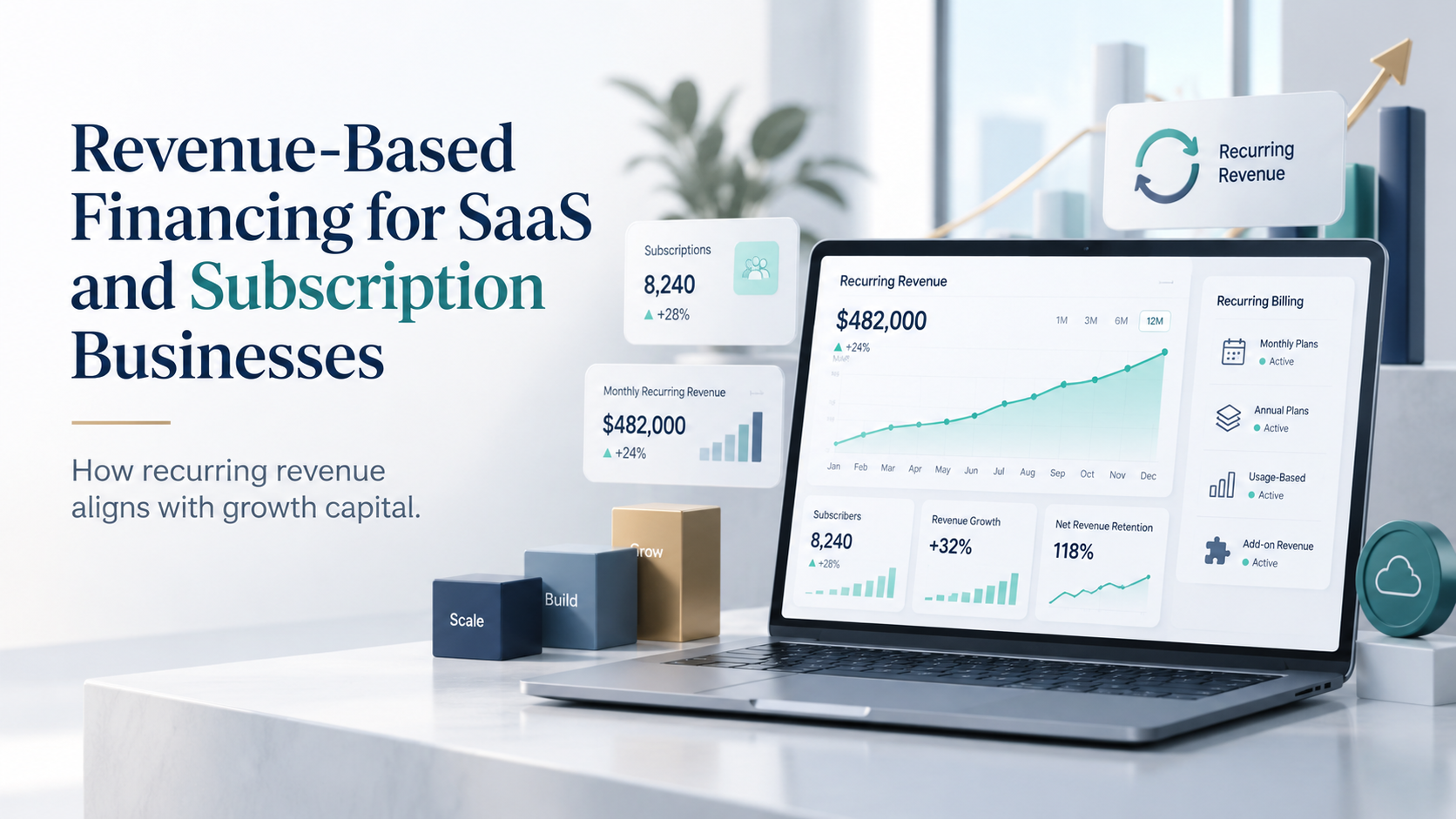
SaaS and subscription businesses run on a financial pattern that’s fundamentally different from most companies: revenue arrives in small, recurring pieces rather than large, occasional ones, and growth is often funded by spending ahead of the recurring revenue that spending is meant to generate. That pattern happens to line up closely with how revenue-based financing works — which is part of why it’s become such a common financing tool in this space.
Why recurring revenue is a natural fit
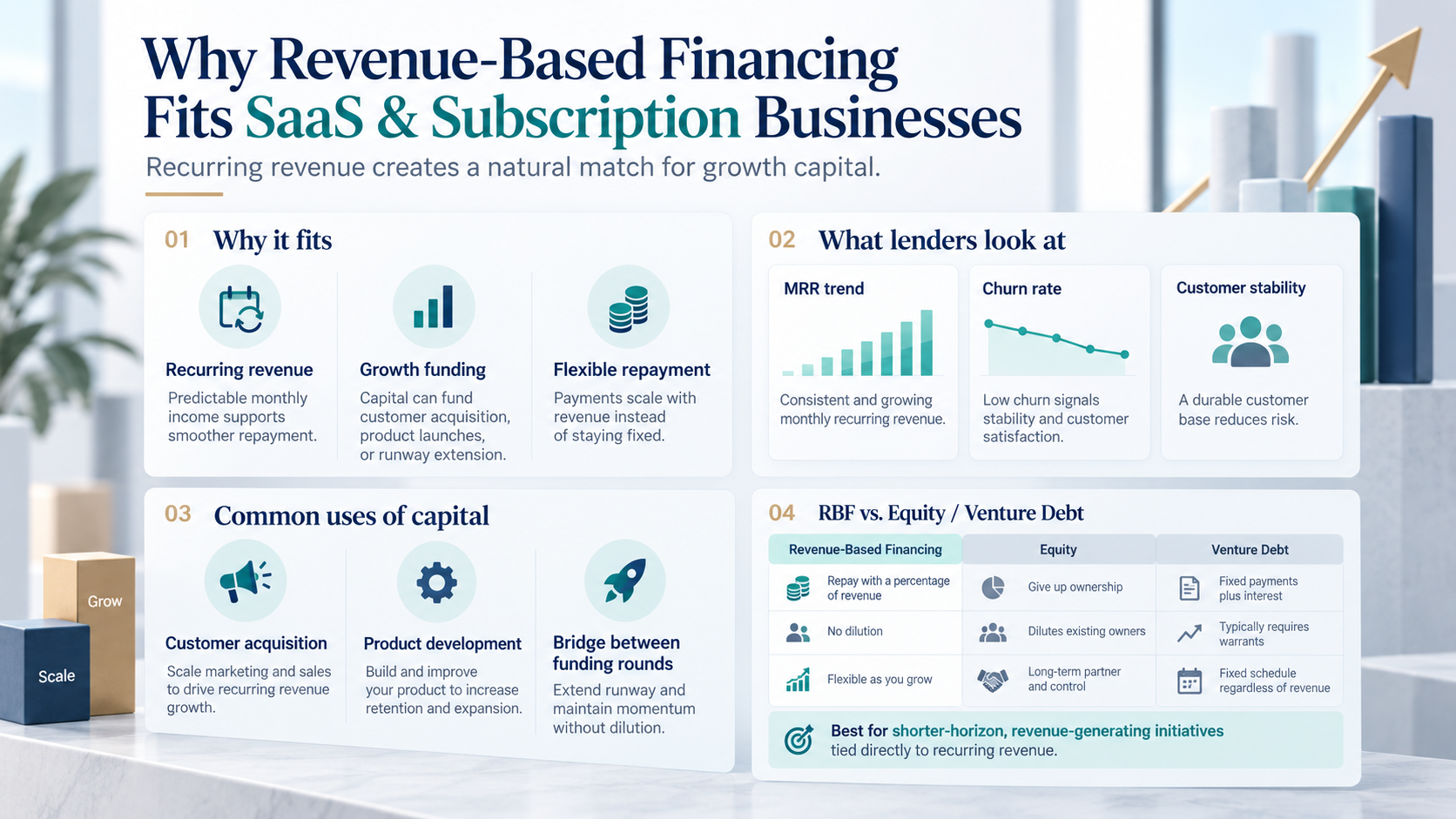
Revenue-based financing works by repaying a percentage of ongoing revenue until a fixed total is reached. For a business with lumpy, unpredictable revenue, that’s a useful hedge. For a SaaS business with recurring, subscription-based revenue, it’s an even more natural match — the revenue base being measured against is inherently more stable and predictable than a typical retail or seasonal business, which can make both the underwriting and the day-to-day repayment experience smoother.
What SaaS businesses typically fund with this capital
Customer acquisition spend. If your business has a reasonably predictable customer acquisition cost and lifetime value, funding a marketing or sales push with revenue-based capital means the very revenue that spend generates is what funds the repayment — a clean, direct line from capital deployed to capital repaid.
Product development ahead of a launch. Building a new feature or product line that’s expected to expand revenue from existing or new customers is a common use case, particularly when the timeline to revenue impact is reasonably well understood.
Bridging between funding rounds. For venture-backed SaaS companies specifically, revenue-based financing is sometimes used alongside or between equity rounds — extending runway or funding a specific initiative without triggering a new dilution event, similar in spirit to venture debt but underwritten more directly against recurring revenue than against overall company stage.
Why founders often prefer this over raising more equity
The same logic that applies to any business considering revenue-based financing over equity applies with particular force in SaaS: a company with strong, recurring revenue and clear unit economics may not need to give up more ownership to access growth capital, if the capital is going toward a specific, revenue-generating initiative with a defined return timeline. The tradeoff, as with any revenue-based structure, is that the total repayment amount is fixed — so the effective cost depends on how quickly your revenue growth allows you to repay it.
What lenders look at specifically for SaaS businesses
Because subscription revenue has its own vocabulary, lenders evaluating a SaaS business for revenue-based financing typically want to understand monthly recurring revenue (MRR) trends, churn rate, and the stability of the existing customer base — not just top-line revenue. A business with strong MRR growth but high churn tells a different underwriting story than one with slower growth but very low churn, even if the current revenue numbers look similar. Being able to speak clearly to these metrics, not just overall revenue, tends to strengthen an application.
A consideration specific to subscription pricing models
If your business is in the middle of a pricing change, a shift from monthly to annual billing, or a significant change in your customer mix, it’s worth discussing directly with a funding specialist how that transition affects how your revenue is measured for repayment purposes. A revenue definition that doesn’t account for a pricing transition already underway can create a mismatch between what a lender expects and what your actual cash flow looks like during the transition period.
How this compares to venture debt for the same company
Some growth-stage SaaS companies are candidates for both revenue-based financing and venture debt, and the right choice often comes down to what the capital is for. Venture debt tends to fit longer-horizon runway extension for a venture-backed company with institutional equity behind it. Revenue-based financing tends to fit a more specific, shorter-horizon initiative with a clearer, more immediate line to the revenue that will repay it. Many SaaS companies use both at different points, rather than treating them as competing options.
FAQ
Does my SaaS business need to be venture-backed to qualify for revenue-based financing? No — unlike venture debt, revenue-based financing is generally underwritten against your revenue history and trajectory rather than requiring institutional equity backing, which can make it accessible to bootstrapped or founder-owned SaaS businesses as well.
How does churn affect my eligibility or terms? Churn is one of several factors a lender considers alongside revenue growth and stability — high churn doesn’t automatically disqualify a business, but it’s a factor that shapes how a lender evaluates the reliability of your revenue base.
Can I use revenue-based financing more than once as my company grows? Many SaaS companies use it repeatedly across growth stages, particularly for specific initiatives with a clear expected revenue return, rather than as a one-time financing event.