Revenue-based financing is often described as ideal for seasonal businesses, and in broad strokes that’s true — repayment that scales with revenue naturally accommodates a business with strong and weak months. But “accommodates seasonality” doesn’t mean seasonality is invisible to the structure. Understanding how a lender actually accounts for seasonal patterns helps you evaluate an offer more accurately, rather than assuming any revenue-based structure will automatically fit your calendar.
Why seasonality shows up in underwriting, not just repayment
A lender structuring a revenue-based facility isn’t just picking a percentage of revenue at random — they’re modeling how your specific revenue pattern is likely to play out across the repayment period. A highly seasonal business with a concentrated peak and long slow stretches presents a different repayment timeline than a business with steady, consistent revenue, even if their annual totals are similar. This affects not just how comfortable the structure will feel month to month, but potentially the terms offered in the first place.
What a lender typically wants to see from a seasonal business
At least one full seasonal cycle of revenue history, ideally more, so the pattern can be distinguished from a one-time anomaly. A business in only its first season has less data to underwrite against, which can affect either the terms offered or the amount of financing available.
Consistency of the pattern itself. A seasonal business whose peak-to-trough ratio is relatively stable year over year is easier to underwrite confidently than one whose seasonality has been unpredictable or is actively shifting, for example due to a changing customer base or market conditions.
A realistic view of the off-season. Lenders want to understand not just how strong your peak is, but how your business manages cash flow during slower months — since the repayment obligation continues, at a reduced pace, even during the off-season.
How this affects the structure of the offer itself
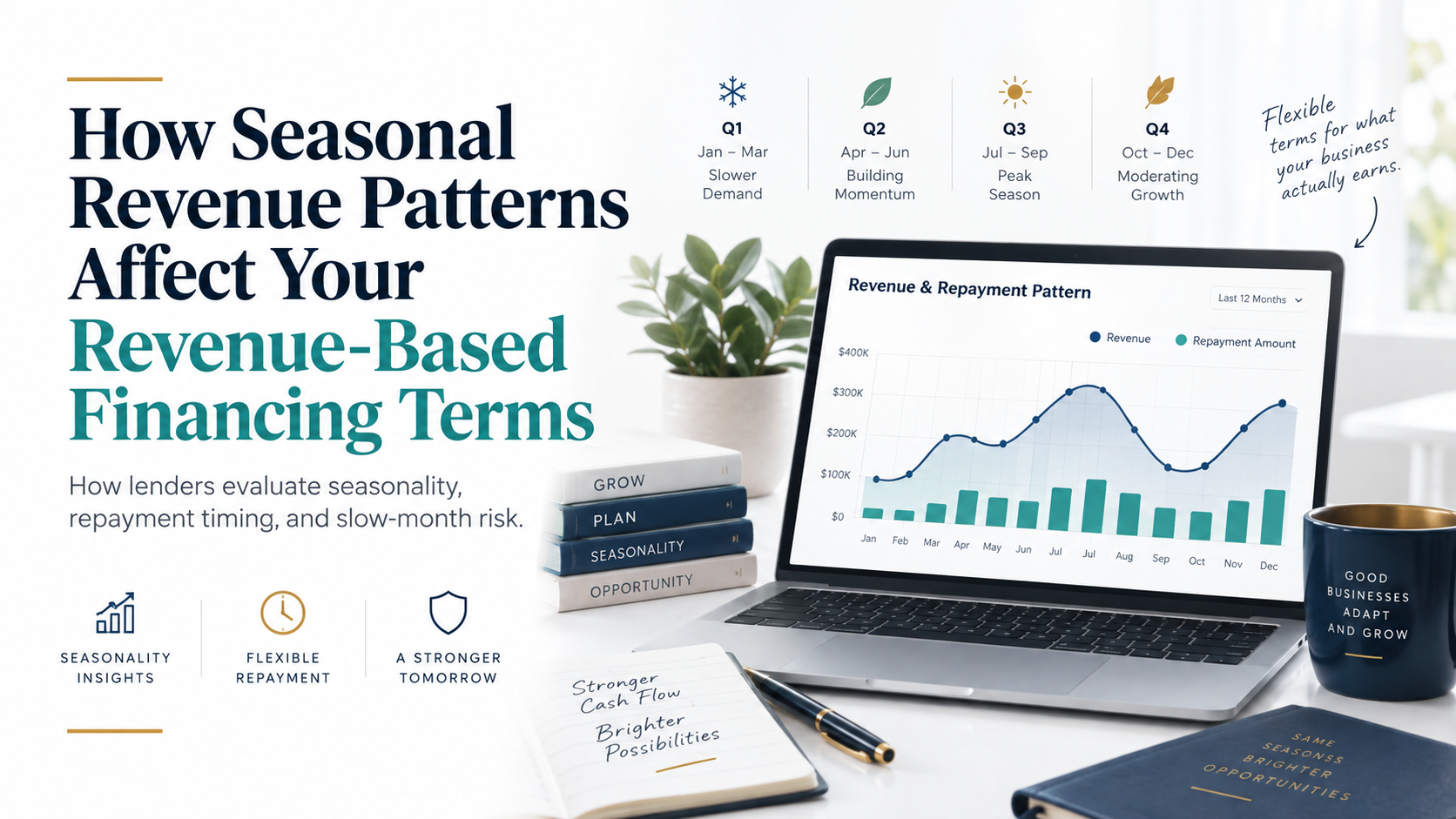
For a highly seasonal business, some lenders build in an understanding that a large share of repayment will happen during peak months, with a smaller, steadier trickle during the off-season, rather than expecting a perfectly even distribution across the year. This is worth discussing explicitly rather than assuming — ask directly how the offer expects repayment to distribute across your specific seasonal pattern, and whether that expectation matches your own.

A key question to ask about the off-season specifically
Some agreements include a minimum payment floor, even during very slow periods, to ensure some ongoing repayment activity regardless of revenue. Understand whether your specific offer includes this, and if so, whether your business’s typical off-season revenue comfortably supports it. A minimum floor that doesn’t account for how quiet your slowest months genuinely are could create strain precisely when your business has the least cash flow cushion to absorb it.
Why more than one season of data matters for you, too
Beyond what a lender needs to see, having at least one full cycle of your own revenue data mapped out helps you evaluate whether a specific offer’s assumptions about your seasonality actually match reality. If an offer’s implied repayment expectations look meaningfully different from how your revenue has actually distributed across past cycles, that’s worth raising directly before you commit, not discovering mid-cycle.
Comparing offers as a seasonal business
When comparing multiple revenue-based financing offers, don’t just compare the headline percentage and total repayment amount — compare how each lender’s structure is likely to feel across your specific seasonal pattern. An offer with a slightly higher total cost but a repayment structure that genuinely matches your calendar may be a better fit than one with a marginally lower cost but assumptions that don’t reflect how your business actually operates across the year.
FAQ
Does having a highly seasonal business limit which lenders will offer revenue-based financing? Not necessarily, but it does affect how confidently a lender can underwrite the offer, which can influence terms. A longer, more consistent history of seasonal data generally improves both the availability and the terms of an offer.
Can the repayment structure be customized to my specific seasonal pattern? Some lenders offer more customization than others — this is worth asking about directly, particularly if your seasonality is pronounced or unusual relative to your industry’s typical pattern.
What if my business is newly seasonal, or my seasonal pattern is changing? This is worth a direct, honest conversation with a funding specialist, since a shifting pattern is harder to underwrite confidently than an established, consistent one — but it doesn’t necessarily rule out revenue-based financing as an option.