The first question most business owners ask about asset-based lending isn’t “how does it work” — it’s “does what I own actually qualify?” It’s a fair question, because not every asset is treated equally, and understanding which of your assets carry the most borrowing power can shape how you approach financing altogether.
Accounts receivable
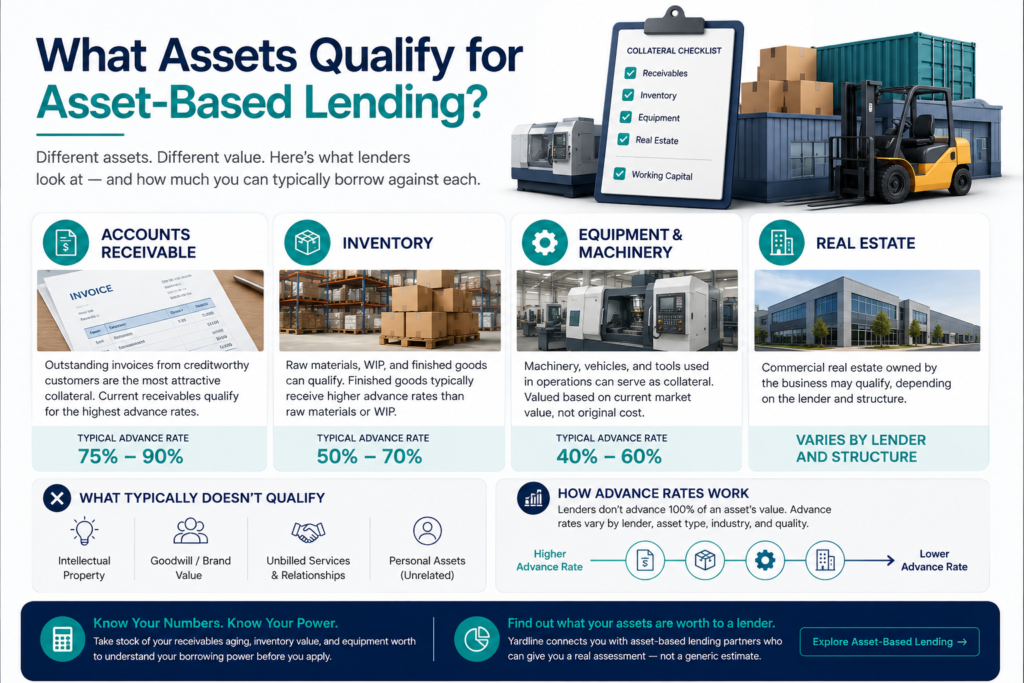
Outstanding invoices from creditworthy customers are typically the most attractive collateral in an asset-based facility, because they’re the closest thing to cash — your customer already owes the money, and payment is generally a matter of when, not if. Lenders typically advance a higher percentage against receivables than against other asset types, though the exact figure depends on the age of the receivables and the creditworthiness of the customers who owe them. Older, past-due invoices are typically excluded or advanced at a lower rate, since the likelihood of collection declines the longer an invoice goes unpaid.
Inventory
Raw materials, work-in-progress, and finished goods can all serve as collateral, though inventory is generally advanced at a lower percentage of value than receivables — it’s less liquid, harder to value precisely, and carries more risk if it needs to be sold quickly. Finished goods that are ready to sell typically qualify for a higher advance rate than raw materials or work-in-progress, since they’re closer to becoming a completed, sellable transaction.
The type of inventory matters too. Fast-moving, easily resellable inventory tends to be viewed more favorably than highly specialized or perishable inventory that would be difficult to liquidate if needed.
Equipment and machinery
Equipment used in your operations — manufacturing machinery, vehicles, specialized tools — can serve as collateral, typically valued based on current market value rather than what you originally paid for it. Depreciation matters here: equipment loses value over time, and a lender’s assessment reflects what the equipment could realistically be sold for today, not its original purchase price.
Real estate
In some structures, commercial real estate owned by the business can be included as part of an asset-based facility, though this is less universal than receivables, inventory, or equipment, and depends heavily on the specific lender.
What typically doesn’t qualify
Intangible assets — intellectual property, brand value, customer relationships that aren’t formalized into receivables — generally don’t serve as collateral in a traditional asset-based structure, even though they may represent real value to your business. Personal assets unrelated to the business are also generally outside the scope of a business asset-based facility, unless the structure specifically involves a personal guarantee, which is a separate consideration from the asset-based collateral itself.
How the advance rate typically works
Lenders don’t advance 100% of an asset’s value — they build in a cushion in case the asset needs to be liquidated to recover the loan. Advance rates vary meaningfully by lender and asset type, but as a general pattern, receivables tend to receive the highest advance rates, finished inventory somewhat lower, and equipment often lower still, reflecting the relative liquidity and ease of valuation for each. The specific percentages depend on your lender, your industry, and the quality and age of the specific assets involved — which is exactly why getting a real quote based on your actual asset mix matters more than a general rule of thumb.
A practical way to think about your own asset base
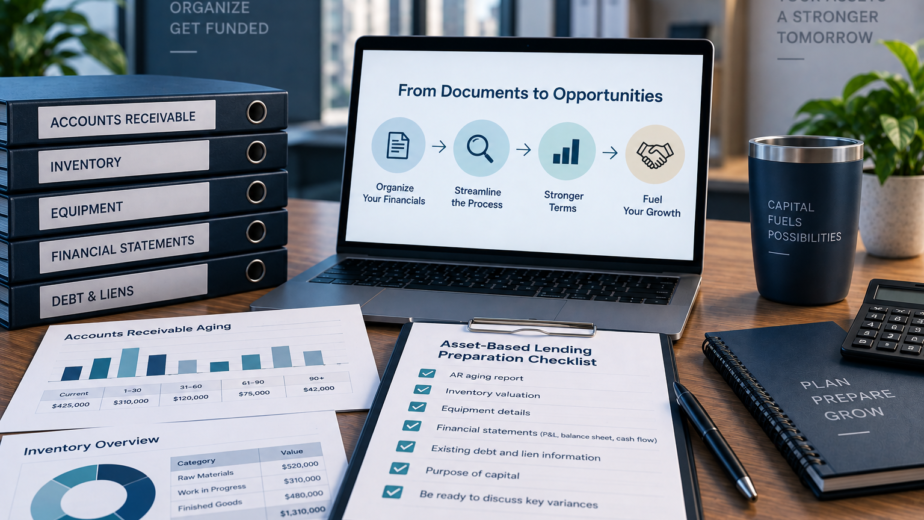
Before applying, it’s worth taking stock of what you actually have: current accounts receivable aging (how much is current vs. 30, 60, 90+ days past due), an approximate current market value of major equipment, and a realistic assessment of your inventory’s liquidity — not just its cost basis. This isn’t just useful for the application; it gives you a clearer sense of how much borrowing capacity your business realistically has before you’re deep into a conversation with a lender.
FAQ
Can I combine multiple asset types in one facility? Yes — many asset-based facilities blend receivables, inventory, and equipment into a single borrowing base, with each asset type contributing according to its own advance rate.
Does the quality of my customers affect how my receivables are valued? Yes. Receivables owed by well-established, creditworthy customers are generally viewed more favorably than receivables from customers with uncertain payment histories, since the lender is ultimately relying on that customer actually paying.
What if my inventory value fluctuates seasonally? This is common, particularly in retail and distribution. Asset-based facilities are often structured to accommodate this, with the available credit adjusting as your qualifying asset base changes throughout the year.