These two products get confused constantly, and it’s understandable — both exist to solve a cash flow gap tied to a sale, and both are common in B2B and wholesale businesses. But they cover two different moments in the same order cycle, and knowing which one applies to your situation can save you from applying for the wrong product entirely.
The order cycle, and where each product fits
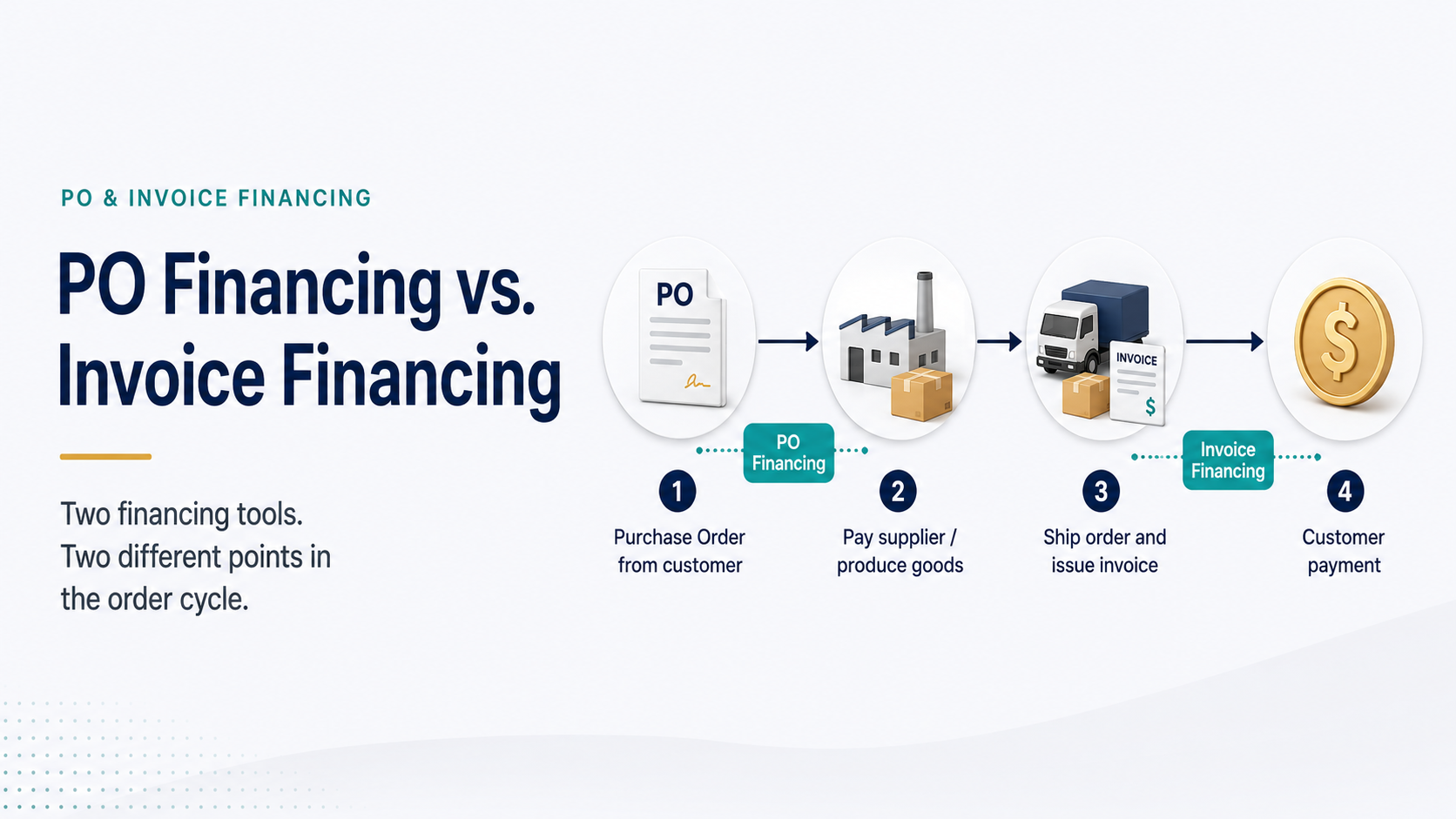
Think about the full lifecycle of a B2B order:
- You receive a purchase order from a customer.
- You pay your supplier to produce or acquire the goods.
- You fulfill and ship the order, and issue an invoice to your customer.
- Your customer pays the invoice, on whatever payment terms you agreed to.
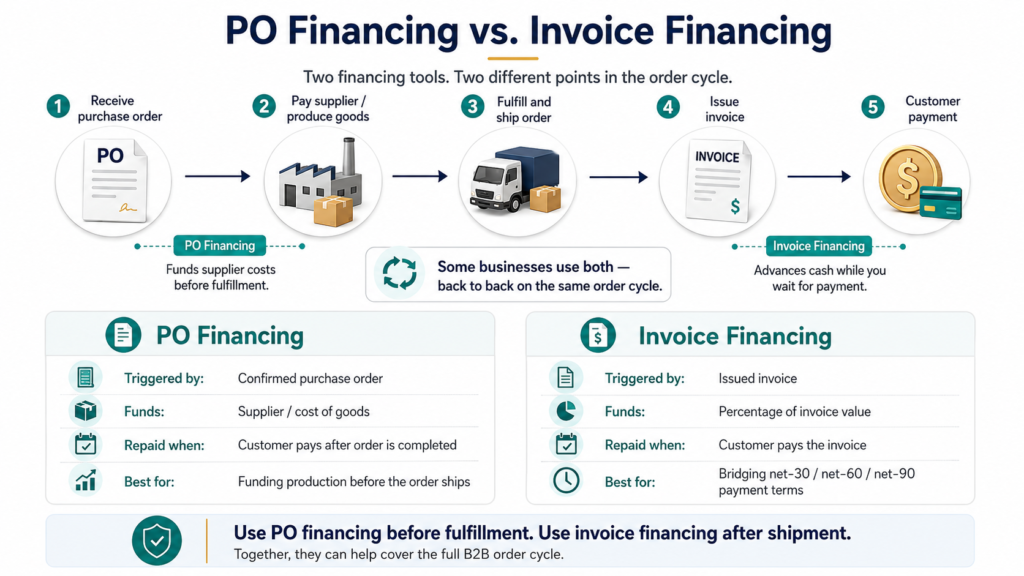
PO financing covers the gap between steps 1 and 2 — it funds the cost of goods needed to fulfill an order you’ve already won, before you’ve paid your supplier.
Invoice financing covers the gap between steps 3 and 4 — it advances you cash against an invoice you’ve already sent, while you wait for your customer to actually pay it.
They’re sequential, not competing. Some businesses use both, back to back, on the same order: PO financing to fund production, and invoice financing to bridge the payment gap once the order ships.
PO financing, in short
- Triggered by: a confirmed purchase order from your customer
- Funds: the cost of goods needed to fulfill that order — often paid directly to your supplier
- Repaid when: your customer pays for the completed, delivered order
- Best for: businesses that need capital before they can even produce or acquire the goods for an order
Invoice financing, in short
- Triggered by: an invoice you’ve already issued for a completed, shipped order
- Funds: a percentage of the invoice value, advanced before your customer’s payment is due
- Repaid when: your customer pays the invoice, at which point the advance is settled and any remaining balance released to you
- Best for: businesses that have already fulfilled the order but are waiting out a 30, 60, or 90-day payment term
A concrete example that uses both
Imagine a wholesale apparel company that lands a large order from a national retail chain. The company doesn’t have enough cash on hand to pay its overseas manufacturer for the full production run. It uses PO financing to cover that upfront supplier cost, based on the confirmed order from the retailer. Production completes, the order ships, and the company invoices the retailer under standard net-60 terms. Rather than wait two months to get paid, the company uses invoice financing to access a percentage of that invoice value immediately, using the retailer’s payment (once it arrives) to settle the advance.
In this example, PO financing solved the “we can’t afford to make the product” problem, and invoice financing solved the “we made and shipped it, now we’re waiting to get paid” problem. Neither product alone would have covered the full gap — together, they cover the entire order cycle.
How to know which one you actually need
Ask yourself where you are in the order cycle right now:
- Haven’t paid your supplier yet, and need to? That’s PO financing.
- Already shipped the order and issued an invoice, just waiting on payment? That’s invoice financing.
- Both — you need to fund production and you’ll also face a long payment term once it ships? Some businesses structure financing to cover both stages, which is worth discussing directly with a funding specialist rather than trying to piece together separately.
FAQ
Can I use PO financing and invoice financing with different lenders? Yes, though using a marketplace that has visibility into both makes it easier to structure financing that covers the full order cycle without gaps or redundant underwriting.
Which one is faster to arrange? Both can move relatively quickly compared to traditional loans, since each is underwritten around a specific, verifiable transaction rather than a full business review. Actual timelines depend on the lender and the complexity of the order or invoice.
Do I need to choose one or the other, or can my business use both regularly? Many wholesale, manufacturing, and distribution businesses use both as a standard part of their working capital strategy — PO financing to fund production, invoice financing to bridge payment terms — especially when dealing with large retail or enterprise customers on long payment terms.