A strong quarter, an unexpected influx of cash, or simply faster growth than projected can leave a business with the ability to pay off its revenue-based financing well ahead of schedule. Whether that’s a good idea — and what actually happens when you do it — depends on details that are easy to overlook when the offer was first signed.
Why the total repayment amount matters here
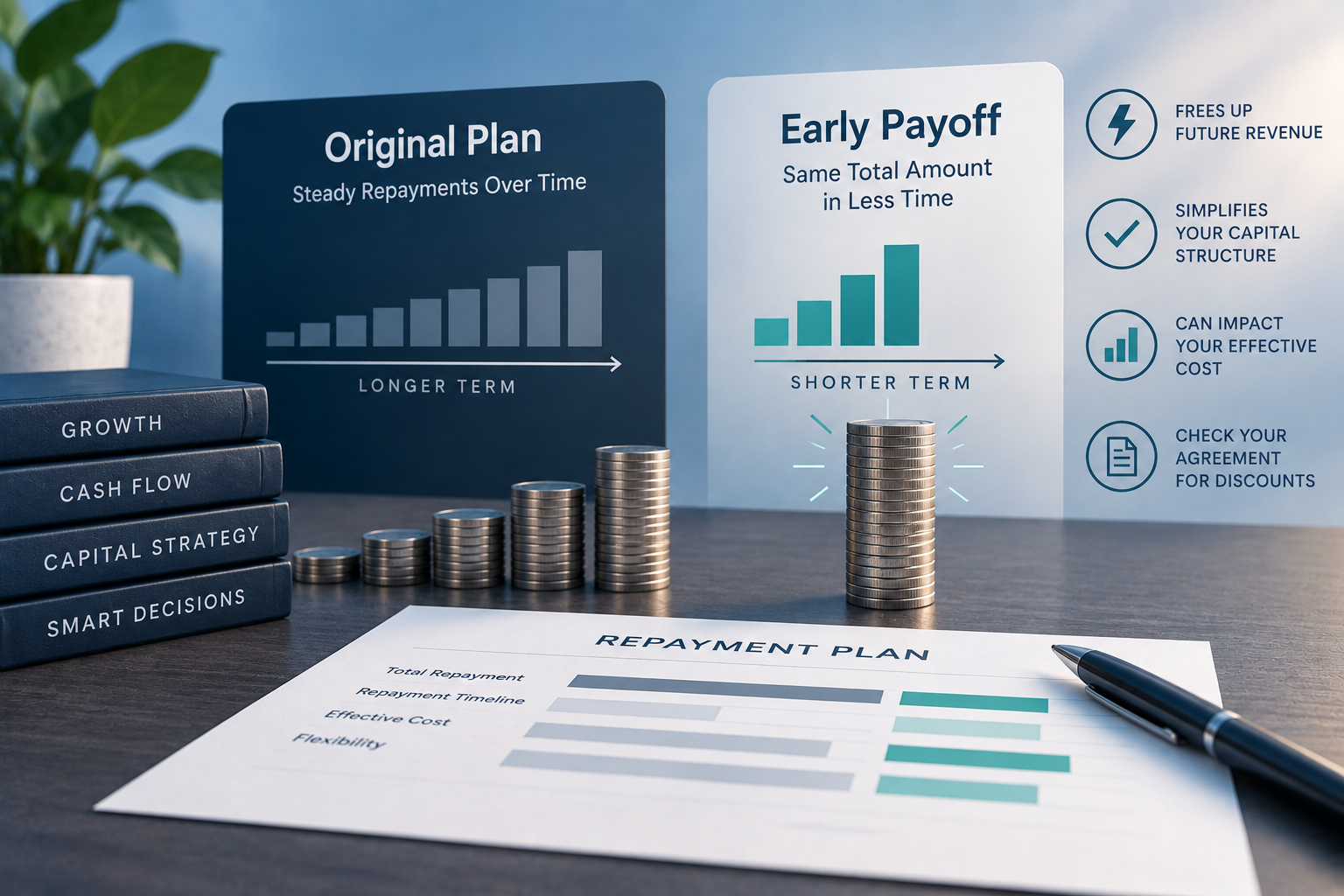
Revenue-based financing typically involves a fixed total repayment amount, agreed upfront, that you pay down through a percentage of revenue until the full amount is reached. Because that total is fixed regardless of how quickly you reach it, paying it off early doesn’t reduce the total dollar amount owed in most standard structures — it simply means you reach that same total faster than the original projection assumed.
Why this actually raises your effective cost of capital
This is the counterintuitive part: if the total repayment amount is fixed, repaying it faster means you’re paying the same total dollar cost over a shorter period of time — which, expressed as an annualized rate, is actually a higher effective cost than if you’d repaid it more slowly. A business that repays enthusiastically ahead of schedule, without understanding this dynamic, may be paying a much higher effective rate than they realized when comparing the offer to alternatives.
Whether early repayment discounts exist
Some revenue-based financing agreements do include an early repayment discount — a reduction in the remaining balance if you pay off the facility ahead of schedule, which meaningfully changes the math described above. This is not universal, and it’s a critical detail to check in your specific agreement rather than assume either way. If your agreement includes this discount, early repayment can genuinely reduce your total cost. If it doesn’t, early repayment simply compresses the same total cost into a shorter timeframe.
When early repayment still makes sense, discount or not
Even without an explicit discount, there can be reasons to repay early: freeing up a percentage of future revenue that would otherwise continue going toward repayment, simplifying your capital structure ahead of raising equity or another financing round, or simply preferring to close out the obligation rather than have it continue for its original projected timeline. These are valid reasons independent of whether early repayment reduces your total dollar cost.
When it’s worth reconsidering
If your primary motivation for repaying early is a belief that it will reduce your total cost, and your specific agreement doesn’t include an early repayment discount, it’s worth pausing and confirming that belief against your actual contract terms before proceeding. In that scenario, the capital you’d use for early repayment might be better deployed elsewhere in the business, since repaying early doesn’t provide the cost savings you might be assuming.
How to check your specific agreement
Look directly at your contract for language about prepayment, early repayment discounts, or similar terms — and if it’s not immediately clear, ask your lender directly for a specific dollar comparison: what would you owe in total if you repay on the original projected timeline, versus what you’d owe if you repaid immediately. That direct comparison removes any ambiguity about whether early repayment actually benefits you financially.
A broader lesson about revenue-based financing structures
This dynamic is a good example of why understanding the full structure of a revenue-based financing offer — not just the headline percentage and flexibility pitch — matters before you sign. Structures that sound simple on the surface, like “repay whenever your revenue allows,” can have real financial nuances that only become apparent once you’re actually managing the repayment in practice.
FAQ
Is it ever a bad idea to pay off revenue-based financing early? Not inherently bad, but it’s worth confirming that your specific reason for doing so — cost savings, simplifying your capital structure, or something else — actually holds up against your contract’s specific terms, since the assumption of automatic cost savings isn’t universally true.
How do I find out if my agreement includes an early repayment discount? Check your original contract directly, or ask your lender for clear, written confirmation — this shouldn’t require guesswork, and a transparent lender should answer this question plainly.
Does paying off early affect my ability to get future financing from the same lender? This varies by lender — some view a strong repayment history, including early repayment, favorably for future financing conversations, though it’s worth discussing directly with your specific lender.