A line of credit that was generous when you first got it can quietly become a constraint a year or two later, simply because your business changed and the facility didn’t. Unlike a sudden cash crisis, outgrowing a credit line tends to happen gradually — which is exactly why it’s easy to miss until it’s actively limiting decisions you’d otherwise make.
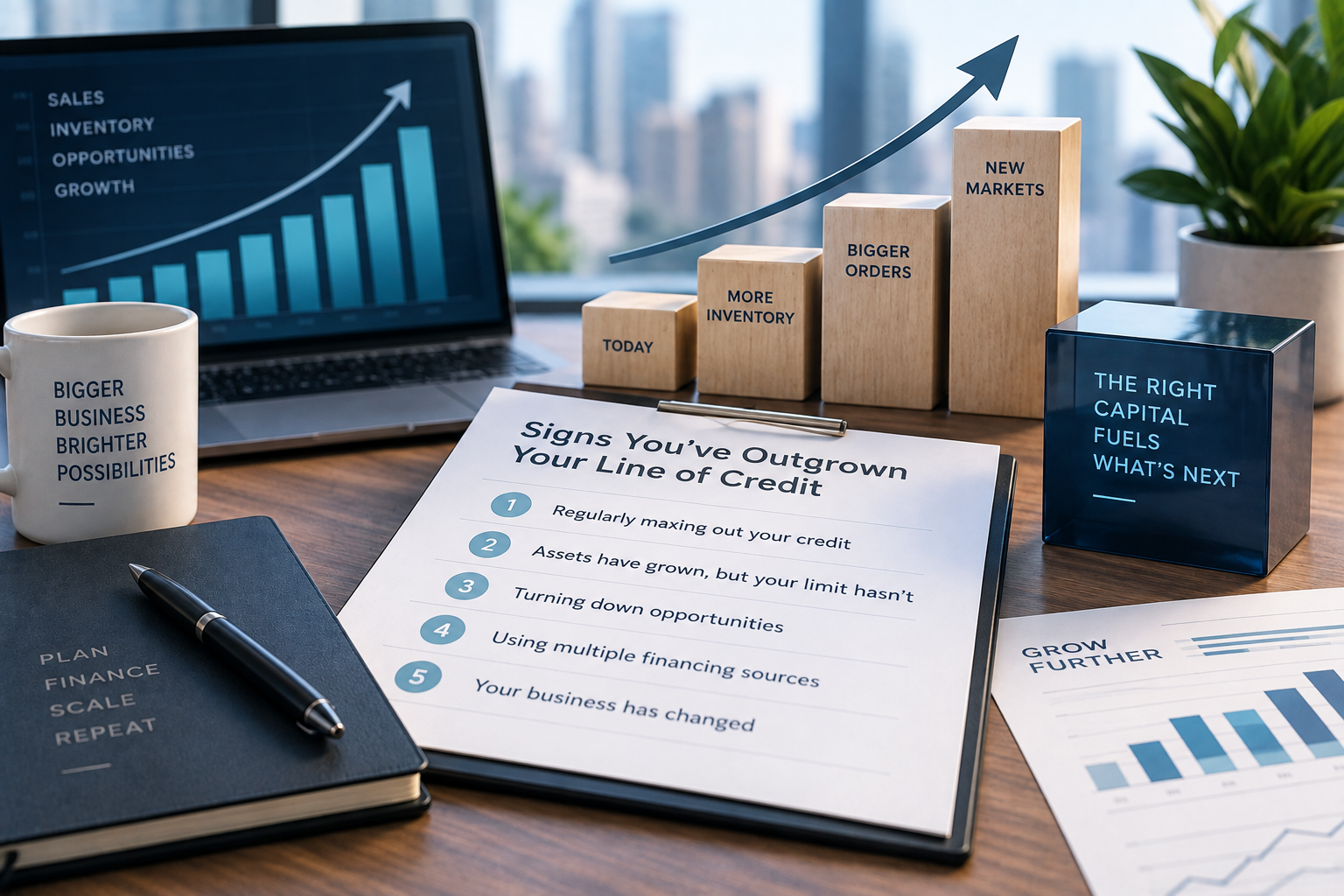
1. You’re regularly maxing out your available credit
If your business consistently draws close to its full credit limit rather than treating it as a cushion for occasional needs, that’s a direct signal the facility’s size no longer matches your operating scale. A credit line that’s meant to provide flexibility stops doing that job once it’s functioning as your primary, fully-utilized source of working capital rather than a backstop.
2. Your receivables or inventory have grown, but your credit limit hasn’t
If your facility is asset-based, the available credit is meant to move with your qualifying asset base. A business whose receivables or inventory have meaningfully grown since the facility was established, without a corresponding increase in available credit, is likely sitting on more borrowing capacity than the current facility recognizes — worth revisiting rather than assuming the original terms are still optimal.
3. You’re turning down or delaying opportunities because of cash constraints
A large new order, a chance to negotiate better supplier pricing with a bigger upfront commitment, or an opportunity to expand that requires more working capital than you currently have access to — if any of these are becoming familiar situations, that’s a sign your financing capacity is now the limiting factor on your growth, rather than demand or opportunity.
4. You’re using multiple financing sources to cover what one facility used to handle
Some businesses respond to an undersized credit line by patching the gap with other financing — a separate short-term loan here, a factoring arrangement there. If you find yourself managing several financing relationships to cover needs that used to fit under a single facility, it’s worth evaluating whether a properly resized primary facility would be simpler and more cost-effective than managing multiple smaller ones.
5. Your business has changed in ways your original facility wasn’t structured around
A business that has added new product lines, entered new markets, or shifted its revenue mix since securing its original facility may have outgrown not just the size of that facility, but its underlying structure. A facility built around a single asset type or a specific revenue pattern may not reflect a business that’s since diversified — worth a full re-evaluation, not just a request for a higher limit on the same structure.
What resizing actually involves
Revisiting a facility doesn’t necessarily mean starting from scratch with a new lender, though it can be a good moment to compare current terms against the broader market rather than assuming your existing lender’s renewal offer is automatically competitive. At minimum, it means providing updated financials and asset information that reflect your business’s current scale, so a lender can properly assess what facility size and structure actually fits your business today, not the version of it that applied a year or two ago.
Why waiting has a real cost
Every month spent operating under a facility that’s too small isn’t neutral — it’s a month of turned-down opportunities, layered financing costs, or unnecessary cash flow stress that a properly sized facility would have avoided. Because updating a facility takes some lead time, it’s worth starting the evaluation as soon as you notice more than one of the signs above, rather than waiting until the constraint becomes acute.
FAQ
Do I need to switch lenders to resize my facility? Not necessarily — many facilities can be reassessed and adjusted with your existing lender, though comparing the market is worth doing periodically regardless of whether you ultimately switch.
How often should I revisit whether my facility still fits my business? There’s no universal schedule, but a meaningful change in your revenue, asset base, or business model is a natural trigger point, independent of how long it’s been since your last review.
Is it a bad sign if I’ve outgrown my original facility? No — it’s a normal, common outcome of business growth. The risk isn’t outgrowing a facility; it’s not noticing and continuing to operate under one that no longer fits.